General information
Photo Gallery
Things To Do
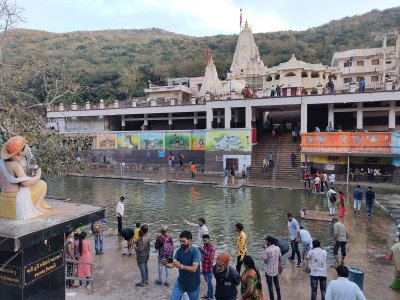
@@Profound Spiritual Significance: Damodar Kund is one of the most sacred Hindu sites in Junagadh, located right at the Taleti (foothills) of the holy Girnar Hill. It is revered as a sacred water tank (kund) that possesses purifying and spiritual properties. The kund is named after Lord Krishna (Damodar), who is the Ishtadev (chief deity) of the local Giri Narayan Brahmin community, who have lived here for millennia. @@The Ritual of Asthi Visarjan: The Kund is immensely famous as a place for the Hindu ritual of Asthi Visarjan (immersion of the ashes and bones of the cremated dead). Hindus believe that immersing the remains of their loved ones here grants the departed soul Moksha (salvation) and peace, a belief comparable to the immersion at the Ganga in Haridwar or Prayag (Allahabad). The water is believed to have natural properties that can dissolve the bones. @@Connection to Narsinh Mehta: The Kund is closely linked to the great 15th-century Gujarati poet-saint and fervent devotee of Krishna, Narsinh Mehta. It is said that he regularly bathed here and composed many of his famous prabhatiyas (morning songs) in the peaceful surroundings of the Kund. A dedicated Narsinh Mehta Temple is located nearby to commemorate this association. @@Surrounding Temples and Pilgrimage Hub: The Damodar Kund is part of a larger, active religious complex that includes the Damodar Hari Temple (dedicated to Lord Damodar and Radha Rani), the Baladeva Temple, and the Vagheshwari Temple. It serves as the official starting point for the ascent of the Girnar steps and the annual Lili Parikrama pilgrimage.

@@Antiquity and Historical Context: The Khapra Kodiya Caves, also known as the Khapara Kodia Caves or Khangar Mahal, are the oldest and plainest of the Junagadh Buddhist Cave Groups. They are dated to the 3rd-4th century BC (or possibly early AD), making them contemporary with, or soon after, the period of Emperor Ashoka. These caves represent one of the earliest monastic settlements in the region, initially carved to serve as vihara (monks' quarters) and resting places during the vassa (rainy season retreat). @@Original Design and Decline: The caves were originally carved out of an east-west longitudinal ridge near the edge of the ancient Sudarshan Lake. They were structurally simple, featuring small rooms and unique L-shaped residences and water tanks. The complex was abandoned after many years of use because cracks in the rock allowed water to seep into the living quarters, rendering them unusable. Historical accounts suggest the monks later migrated to Maharashtra, where they developed the more elaborate cave architecture seen there. @@Current State of Preservation: The caves have suffered significantly due to later quarrying activity and natural erosion, and now only the highest story and a few remnants of the original structure remain. They are considerably plainer and less well-preserved than the nearby Bawa Pyara Caves and the later Uparkot Caves, yet their age makes them highly important archaeologically. @@Evidence of Early Buddhist Influence: The presence of these ancient caves confirms the strong and early patronage of Buddhism in the Junagadh region, linking it directly to the expansion of the faith during the Mauryan and post-Mauryan periods.
Information
Tourism Tips
Reviews
Information about New and Updated Locations(12+) of Has Been Added :-
Card subtitle
Vaitarna DamLal Bangla WaterfallDaman and DiuGoaJaniganj BazarJaniganj BazarPamban Bridge Urban Eco ParkPlace Name.More PlacesNote:-
Information provided here in good Faith and for reference only.
All information and pictures will be updated soon, please keep visiting.