

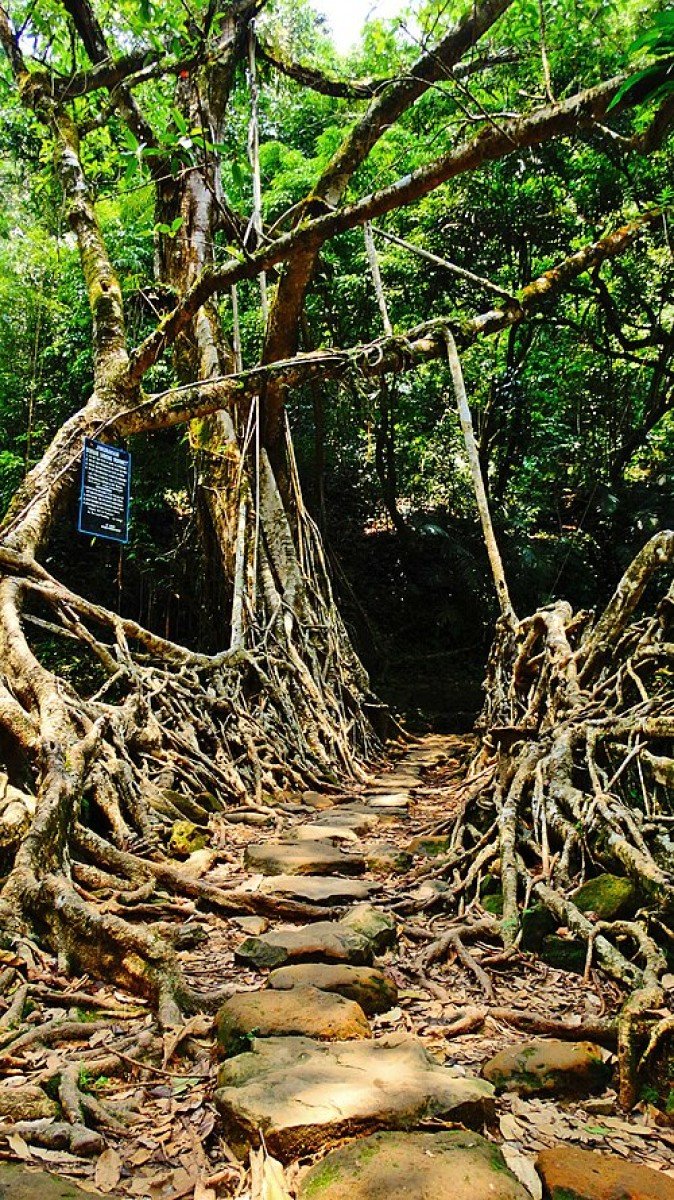
Jingmaham Root Bridge
General information
-
Ideal Duration:
1 to 2 HoursPlace Type:
Living ArchitectureEntry Fees:
Standard Entry Fee: The entry fee is typically 40 INR for adults and 20 INR for children. There is an additional camera fee of 50 INR. The funds are managed by the village council for the upkeep of the path and ecological conservation of the sacred grove. ...Standard Entry Fee: The entry fee is typically 40 INR for adults and 20 INR for children. There is an additional camera fee of 50 INR. The funds are managed by the village council for the upkeep of the path and ecological conservation of the sacred grove.Timing:
Regular Timings: Open from 8:00 AM to 5:00 PM.
Ideal Visit Time: Early morning at 8:30 AM is best to avoid the midday heat and the influx of day-trippers from Shillong. During the monsoon, it is best to visit during a break in the rain to s...Regular Timings: Open from 8:00 AM to 5:00 PM.
Ideal Visit Time: Early morning at 8:30 AM is best to avoid the midday heat and the influx of day-trippers from Shillong. During the monsoon, it is best to visit during a break in the rain to see the river in its full glory.Special Events:
Nohwet Community Day: Once a year, the village comes together to maintain the bridge. This involves weaving new tender roots into the existing structure. Visitors during this time can witness the actual process of "growing" the bridge, accompanied by community songs and tr...Nohwet Community Day: Once a year, the village comes together to maintain the bridge. This involves weaving new tender roots into the existing structure. Visitors during this time can witness the actual process of "growing" the bridge, accompanied by community songs and traditional Khasi snacks like Putharo.Best Photo Spots:
The Center Span: Standing in the middle of the bridge provides a perspective of the root geometry.
The River Bed: Shooting upwards from the river boulders captures the bridge against the jungle canopy.
Village E...The Center Span: Standing in the middle of the bridge provides a perspective of the root geometry.
The River Bed: Shooting upwards from the river boulders captures the bridge against the jungle canopy.
Village Entry Gate: The traditional bamboo gate of Nohwet village offers a perfect rustic frame.Photo Gallery
Things To Do
-
Cultural Trekking: Walking down the stone steps from Nohwet village to the bridge is a cultural journey.
Swimming in Crystal Pools: The river under the bridge has natural turquoise pools where visitors can take a refreshing dip.
Nature Journaling: The biological diversity here is immense; many visitors spend time sketching the intricate root patterns.
Village Homestay Experience: Staying in Nohwet allows you to learn the art of root training from elders.
Learning Indigenous Wisdom: You can engage in workshops about Khasi herbal medicine practiced in the area.
Sustainable Shopping: Buy handmade bamboo crafts from the villagers near the bridge entrance.
Photography of...Cultural Trekking: Walking down the stone steps from Nohwet village to the bridge is a cultural journey.
Swimming in Crystal Pools: The river under the bridge has natural turquoise pools where visitors can take a refreshing dip.
Nature Journaling: The biological diversity here is immense; many visitors spend time sketching the intricate root patterns.
Village Homestay Experience: Staying in Nohwet allows you to learn the art of root training from elders.
Learning Indigenous Wisdom: You can engage in workshops about Khasi herbal medicine practiced in the area.
Sustainable Shopping: Buy handmade bamboo crafts from the villagers near the bridge entrance.
Photography of the Root Mesh: Capturing the macro details of the intertwined roots is a popular activity for artists.
Information
-
Why Famous:
UNESCO Tentative Heritage: The bridge is famous for being part of the UNESCO tentative list of world heritage sites. It showcases the ancient Khasi tradition of Jingkieng Jri. It is renowned globally for its durability, as these bridges actually get stronger during monsoon...UNESCO Tentative Heritage: The bridge is famous for being part of the UNESCO tentative list of world heritage sites. It showcases the ancient Khasi tradition of Jingkieng Jri. It is renowned globally for its durability, as these bridges actually get stronger during monsoons, unlike steel or wooden bridges that rot. -
Architecture:
Ficus Elastica Bio-Engineering: The architecture is a marvel of patience. The bridge spans approximately 30 meters across the stream. The primary "beams" are thick, ancient roots that have been guided through hollowed-out Areca palm trunks. The walking path is paved with ...Ficus Elastica Bio-Engineering: The architecture is a marvel of patience. The bridge spans approximately 30 meters across the stream. The primary "beams" are thick, ancient roots that have been guided through hollowed-out Areca palm trunks. The walking path is paved with flat stones tucked into the root mesh, providing a stable surface. The handrails are also made of living roots, woven together in a lattice pattern that stands about 1. 2 meters high. -
How To Reach:
By Air: Fly into Shillong Airport and take a taxi toward Pynursla.
By Train: Reach Guwahati Railway Station and use a shared sumo to Pynursla.
By Road: The drive from Shillong takes about 2. 5 hours through ...By Air: Fly into Shillong Airport and take a taxi toward Pynursla.
By Train: Reach Guwahati Railway Station and use a shared sumo to Pynursla.
By Road: The drive from Shillong takes about 2. 5 hours through scenic hills.
By Local Transport: Hire a local taxi from the Pynursla market stand specifically for Nohwet village. -
Weather and Best Time to Visit:
Autumn (October to November): The sky is clear, and the river water is at its most transparent.
Spring (March to April): The forest is in full bloom with wild flowers.
Mid-Morning: The sunlight filters throu...Autumn (October to November): The sky is clear, and the river water is at its most transparent.
Spring (March to April): The forest is in full bloom with wild flowers.
Mid-Morning: The sunlight filters through the canopy, creating a "God-ray" effect on the roots. -
Near Tourist Places:
1. Mawlynnong (2 KM), 2. Sky Walk (2 KM), 3. Balancing Rock (3 KM), 4. Dawki (30 KM), 5. Byrdaw Falls (18 KM), 6. Borhill Falls (10 KM), 7. Pynursla (18 KM), 8. Riwai Bridge (1 KM), 9. Umngot River (32 KM), 10. Mawlynnong Church (2 KM).
Tourism Tips
-
Health & Safety: Use insect repellent as leeches can be active during the damp season.
Packing: Wear light, breathable cotton clothes.
Accommodation: Highly recommend the Nohwet Bamboo Guesthouse.Health & Safety: Use insect repellent as leeches can be active during the damp season.
Packing: Wear light, breathable cotton clothes.
Accommodation: Highly recommend the Nohwet Bamboo Guesthouse.
Cash & Connectivity: No ATMs nearby; keep cash for entry fees and local snacks. Mobile data is extremely slow; enjoy the digital detox.
Reviews
FAQs
Pynursla Itineray And Cost:-
Jingmaham Root Bridge Tourism:-
Other Places In Pynursla :-
Other States In India :-
Information about New and Updated Locations() of Meghalaya Has Been Added :-
Card subtitle
Note:-
Information provided here in good Faith and for reference only.
Near Places
Bop Hill Falls
Some quick example text to build on the card title and make up the bulk of the card's content.
Go somewhere
Laitkynsew Village
Some quick example text to build on the card title and make up the bulk of the card's content.
Go somewhere
Mawklot Village
Some quick example text to build on the card title and make up the bulk of the card's content.
Go somewhere
Mawlat Falls
Some quick example text to build on the card title and make up the bulk of the card's content.
Go somewhere
Mawshun Cave
Some quick example text to build on the card title and make up the bulk of the card's content.
Go somewhere
Padu Village
Some quick example text to build on the card title and make up the bulk of the card's content.
Go somewhere
Pynursla Cathedral
Some quick example text to build on the card title and make up the bulk of the card's content.
Go somewhere
Pynursla Market
Some quick example text to build on the card title and make up the bulk of the card's content.
Go somewhere
Sohra Town
Some quick example text to build on the card title and make up the bulk of the card's content.
Go somewherein Other Cities