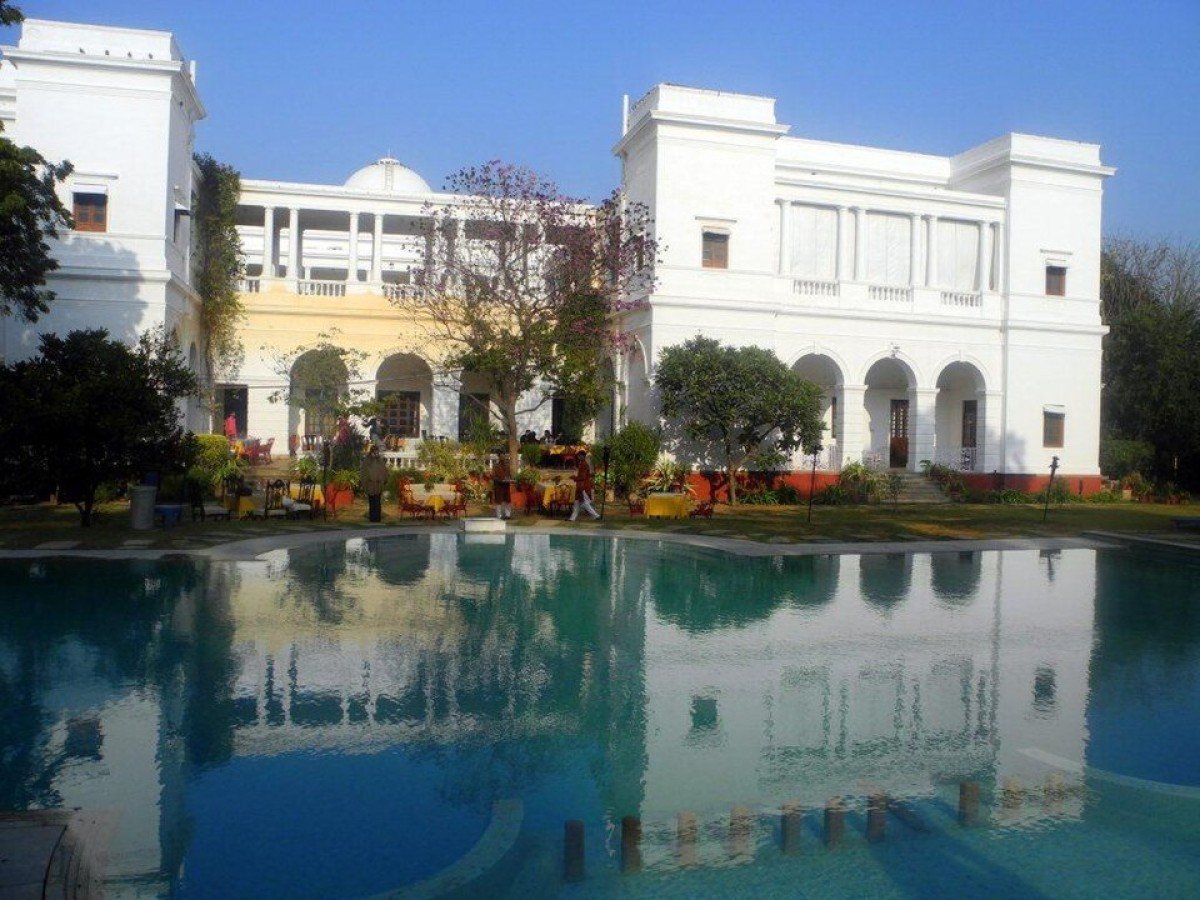
Pataudi Palace
General information
-
Ideal Duration:
1-2 Hours (For viewing exterior/premises from outside only)Place Type:
Heritage/Royal Residence/Film LocationEntry Fees:
Strictly Private Residence Status: The Pataudi Palace is a private family residence and is not a public museum or tourist attraction. Therefore, there are no official Sub Place Entry Fees for visitors. This is a crucial distinction. All visits are limited to viewing the e...Strictly Private Residence Status: The Pataudi Palace is a private family residence and is not a public museum or tourist attraction. Therefore, there are no official Sub Place Entry Fees for visitors. This is a crucial distinction. All visits are limited to viewing the exterior from the public road, and any attempt to enter the property without explicit invitation or arrangement with the owners is considered trespassing and is strictly prohibited. The only exceptions to public entry are when the palace has been temporarily leased for a specific purpose, such as a private function, an event, or a commercial film shoot. In those rare commercial cases, the leasing entity would manage ticket sales or entry fees for their specific event:
The Non-Cost of Exterior Photography: Since the main activity is viewing and photographing the exterior from the public street, the cost associated with visiting is effectively zero, aside from travel expenses. This is important for budget travelers to know, as they can appreciate the architecture and history without paying a hefty admission fee that a typical historical monument would require. The absence of an entry fee emphasizes its status as a landmark rather than a commercial tourist site, which is a key part of its unique visitor experience:Timing:
No Public Access Timings: As a private residence, the Pataudi Palace has no official public visiting hours or regular timings. The gates are kept closed, and entry is restricted to the family, staff, and authorized guests. There is no opening or closing time for general pu...No Public Access Timings: As a private residence, the Pataudi Palace has no official public visiting hours or regular timings. The gates are kept closed, and entry is restricted to the family, staff, and authorized guests. There is no opening or closing time for general public access, and visitors should not expect to walk the grounds or enter the building:
Ideal Visit Time for Photography: The ideal visit time for tourists whose aim is exterior viewing and photography is the early morning (Sunrise to 9:00 AM) or the late afternoon (4:00 PM to Sunset). During these times, known as the 'golden hours,' the soft, warm light of the sun illuminates the palace's grand facade, enhancing the architectural details and minimizing harsh shadows, which is perfect for high-quality photography. These hours also see lower local traffic, allowing visitors to appreciate the palace's serene setting in the Pataudi countryside:
Respectful Viewing Hours: Tourists should plan their exterior viewing during daylight hours, ideally between 9:00 AM and 6:00 PM to ensure clear visibility and security. Visiting late at night is highly discouraged, as the area is secluded and can be considered intrusive to the privacy of the residence:Special Events:
The Annual Pataudi Festival: The town of Pataudi, while generally quiet, hosts local religious and cultural events that draw crowds from surrounding villages. While the palace itself, being a private residence, does not host public 'special events' in the tourist sense, the...The Annual Pataudi Festival: The town of Pataudi, while generally quiet, hosts local religious and cultural events that draw crowds from surrounding villages. While the palace itself, being a private residence, does not host public 'special events' in the tourist sense, the most significant event connected to the family is the winter gathering of the Khan-Kapoor family. During the winter months, especially around December and January, the family often stays at the palace, transforming the quiet town into a temporary hub of celebrity activity. This 'event' is a special occasion for local residents and paparazzi, symbolizing the continuity of the royal family’s connection to their ancestral home:
Local Haryanvi Fairs: The small town of Pataudi occasionally hosts local fairs, or melas, which are vibrant, temporary cultural events. These fairs, often organized around harvest time or major Hindu festivals, are a spectacular display of local Haryanvi culture, including traditional music, dance, and food. These are a unique special event where visitors can witness the community spirit of the region outside the palace gates, offering a rich, authentic cultural experience that is a stark contrast to the palace's European architecture:Best Photo Spots:
The Main Iron Gates and Driveway View: The large, imposing main iron gates of the Pataudi Palace offer a magnificent frame for the grand mansion visible in the background. This spot, taken from a respectful distance outside the compound, is the most iconic and highly sought...The Main Iron Gates and Driveway View: The large, imposing main iron gates of the Pataudi Palace offer a magnificent frame for the grand mansion visible in the background. This spot, taken from a respectful distance outside the compound, is the most iconic and highly sought-after photo opportunity, capturing the grandeur and scale of the palace's frontage:
Corner View of the Colonial Facade: The best photographic angle to capture the blend of European and Indian architectural styles is from one of the corners of the property's boundary wall. This vantage point allows photographers to capture the palace's symmetrical design, the high arched windows, and the expanse of the estate's lush greenery in a single frame, especially during the 'golden hours' of sunrise or sunset:
The Akbar Manzil Contrast Shot: A unique photographic idea is to capture the much older Akbar Manzil (now the Judicial Complex) as a contrasting element to the Pataudi Palace. This photo series tells a visual story of the Pataudi family's history and the evolution of royal architecture in the town, offering a more intellectual and historically deep photographic outcome than a simple glamour shot:Photo Gallery
Things To Do
-
Strolling the Boundary Perimeter: As the palace is a private residence, the primary activity is a reflective stroll around the perimeter of the estate. Visitors can walk along the roads bordering the extensive boundary walls, allowing them to appreciate the sheer scale of the 10-acre property. This activity provides the best exterior views for photography and architectural appreciation of the magnificent structure from a respectful distance:
Historical and Architectural Study: For enthusiasts of colonial and Indo-Saracenic architecture, the primary activity involves a detailed, external study of the palace's design. This includes observing the grand European-style facade, the symmetry, the arched windows, and the blending of styles that define its structure. It’s an exercise in appreciating the work of architects Robert Tor ...Strolling the Boundary Perimeter: As the palace is a private residence, the primary activity is a reflective stroll around the perimeter of the estate. Visitors can walk along the roads bordering the extensive boundary walls, allowing them to appreciate the sheer scale of the 10-acre property. This activity provides the best exterior views for photography and architectural appreciation of the magnificent structure from a respectful distance:
Historical and Architectural Study: For enthusiasts of colonial and Indo-Saracenic architecture, the primary activity involves a detailed, external study of the palace's design. This includes observing the grand European-style facade, the symmetry, the arched windows, and the blending of styles that define its structure. It’s an exercise in appreciating the work of architects Robert Tor Russell and Karl Molt von Heinz, comparing its design to other colonial mansions of the era:
Filming Location Spotting: Given its history as a prominent film set, a fun activity is to re-watch scenes from movies like Veer-Zaara or Eat, Pray, Love and try to identify the exterior shots that were filmed here. This transforms the static viewing experience into an interactive game of cinematic recognition, connecting the physical site with its cultural legacy:
Enjoying Local Pataudi Town Cuisine: Since the palace is in the heart of Pataudi town, a great 'thing to do' is to explore the local food scene. Visitors can sample authentic Haryanvi and local North Indian street food or dine at local establishments in the town. This offers a rich cultural contrast to the palace's high-end, royal image:
Visiting the Akbar Manzil: A constructive activity is to locate and visit the nearby Akbar Manzil, which was the former official residence of the Nawabs. Though now a Judicial Complex, its proximity and historical connection to the Pataudi family provide a deeper, contextual understanding of the area's history, making the trip more educational and complete:
Photography and Landscape Capture: The extensive, well-maintained lawns and the grand facade of the palace, especially under the soft light of early morning or late afternoon, offer exceptional opportunities for landscape photography. The activity focuses on capturing the scale, the colonial detailing, and the peaceful, aristocratic ambiance of the surroundings:
Local Market Exploration: Visitors can spend time exploring the quaint, local markets of Pataudi town. This allows for interaction with the local community, buying regional handicrafts, and experiencing the daily life of a traditional Haryanvi town that hosts this grand royal monument, providing a wholesome local experience:
Information
-
Why Famous:
The Royal Legacy: The palace is primarily famous for its profound connection to the royal lineage of the Nawabs of Pataudi and its current ownership by the prominent Bollywood star Saif Ali Khan and his wife, actress Kareena Kapoor Khan. This association ties the palace to ...The Royal Legacy: The palace is primarily famous for its profound connection to the royal lineage of the Nawabs of Pataudi and its current ownership by the prominent Bollywood star Saif Ali Khan and his wife, actress Kareena Kapoor Khan. This association ties the palace to both historical royalty and contemporary celebrity, making it a unique landmark. It stands as a physical symbol of the former princely state and the aristocratic lifestyle of the Pataudi family, transcending mere architecture to represent a slice of India’s feudal and post-feudal history:
Architectural Magnificence: Designed by a combination of British and Austrian architects, the palace exhibits a spectacular blend of European and Indian styles, often compared to the majestic structures of Imperial Delhi. This grand architectural design, spanning 10 acres with 150 rooms, makes it an object of immense visual interest and study, representing the peak of colonial-era design commissioned by Indian nobility. Its sheer scale and the intricate details of its design, including grand dining halls and arched corridors, contribute to its fame as one of the most expensive and historic private residences in India:
Bollywood Connection: A major source of its modern fame is its extensive use as a filming location for various popular Bollywood and Hollywood movies. Films like Veer-Zaara, Mangal Pandey, Gandhi, My Father, and even the Hollywood movie Eat, Pray, Love have featured the palace's opulent setting and lush grounds. This exposure to a global audience cements its status not just as a historical monument but as an iconic backdrop in cinematic history, constantly refreshing its fame for new generations: -
Architecture:
Design and Conception: The Pataudi Palace’s architectural lineage is rooted in the colonial-era style, specifically commissioned by Nawab Iftikhar Ali Khan to be built in the style of the colonial mansions of Imperial Delhi, similar to the design influence seen in the Impe...Design and Conception: The Pataudi Palace’s architectural lineage is rooted in the colonial-era style, specifically commissioned by Nawab Iftikhar Ali Khan to be built in the style of the colonial mansions of Imperial Delhi, similar to the design influence seen in the Imperial Hotel, Delhi. The palace was completed around 1935. The design work was a collaboration between two European architects: Robert Tor Russell, a well-known British architect who contributed significantly to colonial architecture in India, and the Austrian architect Karl Molt von Heinz. This collaboration resulted in a structure that beautifully merges grand European neoclassical elements with traditional Indian royal aesthetics, a style often referred to as Indo-Saracenic or Colonial Revival. This fusion is evident in the palace's external façade and its internal layout, which is designed for stately functions as well as comfortable family living:
Dimension and Layout: The entire estate of the Pataudi Palace is sprawling, covering an estimated area of over 10 acres. The main palace building itself is monumental, reportedly containing around 150 rooms. Key architectural features include high ceilings, grand arched windows that allow ample natural light, and cool marble floors throughout. The floor plan includes large, luxuriously designed spaces such as a spacious dining hall that can seat up to 22 people, multiple sitting lounges, and seven large bedrooms. The palace features internal arched corridors, a hallmark of its colonial design, decorated with heavy chandeliers and period artwork. A notable feature is the use of harem windows in one of the lounge areas, adding a distinctive Indo-Saracenic touch. The exteriors are characterized by vast, well-manicured lawns, which not only serve as a peaceful setting but also as space for large family gatherings. The refurbishment by Darshini Shah was careful to maintain the structural integrity and historical feel while updating the interiors with modern furniture and rich fabrics, thus preserving the 'old charm' of the Nawab's residence: -
How To Reach:
By Air: The nearest major airport to Pataudi is the Indira Gandhi International Airport (DEL) in Delhi, approximately 60-70 KMS away.
From the airport, one has two main options: The most convenient is to hire a pre-paid taxi or a ride-share ...By Air: The nearest major airport to Pataudi is the Indira Gandhi International Airport (DEL) in Delhi, approximately 60-70 KMS away.
From the airport, one has two main options: The most convenient is to hire a pre-paid taxi or a ride-share service (Uber/Ola) directly to Pataudi Palace in Pataudi town. The journey usually takes between 1. 5 to 2. 5 hours, depending on the notoriously heavy Gurugram-Delhi traffic. Alternatively, one can take the Delhi Metro's Airport Express Line to New Delhi or Aerocity and then switch to the Yellow Line towards Huda City Centre in Gurugram, which is a strategic drop-off point for hiring a local taxi for the final leg of the journey to Pataudi:
By Train: The closest major railway junction is the Gurgaon Railway Station (GGN) or the Rewari Junction (RE). The Pataudi Road Railway Station (PTRD) is the absolute closest local station, which is on the Delhi-Rewari line and is very near the palace. However, very few express trains stop here. The best strategy is to take a mail/express train to the Gurgaon Railway Station (GGN). From GGN, the palace is about 30 KMS away. You can then hire a local auto-rickshaw or a taxi/cab for the final 30-45 minute road journey to Pataudi town. Check the local passenger train schedule from Delhi/Gurugram to Pataudi Road (PTRD) for the most direct, albeit slower, rail option:
By Road (Self-Drive/Taxi): Pataudi town is well-connected by road, lying on the State Highway 26 (SH 26), which runs towards Rewari. From Gurugram City Center, the drive is approximately 26-30 KMS and takes around 45 minutes to 1 hour, depending on traffic, via the Pataudi Road. Visitors can easily hire an intercity cab or use a ride-share service. The road is scenic, passing through semi-urban and rural areas of Gurugram district. The palace is a well-known landmark, making navigation relatively straightforward:
By Local Transport (Bus/Auto): Public bus services operated by Haryana Roadways connect Gurugram bus stand to Pataudi town. Buses are a budget-friendly option but can be crowded and time-consuming. From the Pataudi bus stand, the palace is a short 1-2 KM ride, easily covered by a local auto-rickshaw. Taking the Delhi Metro Yellow Line to a station like Huda City Centre or IFFCO Chowk in Gurugram and then taking a long-distance auto-rickshaw or a local cab is another popular option for tourists: -
Weather and Best Time to Visit:
Different Types of Seasons:
Winter (October to March): Best Time to Visit. The weather during this period is cool and pleasant, with temperatures ranging from 8°C to 25°C. This is the ideal time for viewing the palace, as the cold weather ...Different Types of Seasons:
Winter (October to March): Best Time to Visit. The weather during this period is cool and pleasant, with temperatures ranging from 8°C to 25°C. This is the ideal time for viewing the palace, as the cold weather is perfect for a leisurely stroll outside the perimeter, and this is also the season when the Pataudi family often resides there. The moderate temperature makes the journey from Gurugram comfortable.
Summer (April to June): Worst Time to Visit. The heat is extreme, often exceeding 45°C. Exterior viewing is very difficult and uncomfortable.
Monsoon (July to September): Good Time, but with Caution. The weather is humid, but the rain brings down the temperature. The greenery around the palace is at its most vibrant. However, heavy rains can cause traffic and road issues on the drive from Gurugram:
Different Parts of the Day:Morning (Sunrise to 10:00 AM) Ideal. The air is crisp, and the soft morning light is perfect for photography and admiring the palace's architecture without the harsh glare of midday sun. The traffic is also minimal. Midday (10:00 AM to 3:00 PM) Avoidable. This is when the sun is harshest and the heat is greatest, especially in non-winter months. The light is poor for photography. Evening (4:
00 PM to Sunset): Excellent. The 'golden hour' provides beautiful, warm light for spectacular photos, and the temperature is pleasant again, making for a relaxed atmosphere: -
Near Tourist Places:
Sultanpur National Park (Bird Sanctuary) - 15 KMS (Nature & Wildlife) / Farrukhnagar Fort - 18 KMS (Historical Ruin) / Rewari Heritage Steam Loco Shed - 35 KMS (Rail History) / Shanti Kunj Park, Gurugram - 30 KMS (Park/Relaxation) / Sheetla Mata Mandir - 30 KMS (Pilgrimage) / Cyber Hub, Gurugram - 45 KMS (Modern Dining/Nightlife) / Museum of Folk and Tribal Art - 40 KMS (Culture) / Ambience Mall, Gurugram - 40 KMS (Shopping) / Leisure Valley Park - 35 KMS (Recreation) / Badshahpur Fort - 20 KMS (Local Heritage)
Tourism Tips
-
Health & Safety: Always carry a small medical kit, especially one containing medication for dehydration, as the Gurugram-Pataudi journey can be hot outside of winter. Since the spot is relatively secluded, travel in groups and avoid visiting after dark. Be respectful of th...Health & Safety: Always carry a small medical kit, especially one containing medication for dehydration, as the Gurugram-Pataudi journey can be hot outside of winter. Since the spot is relatively secluded, travel in groups and avoid visiting after dark. Be respectful of the private nature of the property and its security. Do not attempt to climb or cross the perimeter wall, as this is illegal and strictly guarded. Stay hydrated, particularly if visiting in Summer or Monsoon:
Packing Essentials: Carry a good camera or smartphone for excellent exterior photography. Since you are in a semi-rural setting, pack light snacks and water, as high-end convenience stores are not readily available near the palace grounds. Wear comfortable walking shoes for the exterior perimeter walk. If visiting during Winter, carry a light jacket or shawl, as the early mornings and late evenings can be quite chilly:
Accommodation Options: Since the palace is a private home, visitors must seek accommodation elsewhere. The nearest suitable lodging is found back in Gurugram. Recommended areas include Cyber Hub, Golf Course Road, or Sector 29, which offer a wide range of luxury hotels (The Leela, Oberoi) and budget-friendly guesthouses. For a closer, more local experience, basic lodging options may be available in Pataudi town, but quality will be significantly lower than in Gurugram:
Other Tips - Respect & Etiquette: Remember that this is the active private residence of a prominent, well-known family, not a historical monument maintained by the state. Maintain absolute silence and respect the privacy of the occupants. Do not linger excessively in front of the gates or attempt to address the security personnel, as they are not authorized to give tours. The main purpose of the trip should be architectural appreciation and historical context, not celebrity-spotting:
Reviews
FAQs
Gurugram Itineray And Cost:-
Other Places In Gurugram :-
Other States In India :-
Information about New and Updated Locations() of Haryana Has Been Added :-
Card subtitle
Note:-
Information provided here in good Faith and for reference only.
Near Places

AapnoGhar Amusement and Water Park
Some quick example text to build on the card title and make up the bulk of the card's content.
Go somewhere
Aravali Retreat
Some quick example text to build on the card title and make up the bulk of the card's content.
Go somewhere
Aravalli Biodiversity Park
Some quick example text to build on the card title and make up the bulk of the card's content.
Go somewhere
Badshahpur Fort Baoli
Some quick example text to build on the card title and make up the bulk of the card's content.
Go somewhere
Bharat Yatra Kendra
Some quick example text to build on the card title and make up the bulk of the card's content.
Go somewhere
Camp Tikkling
Some quick example text to build on the card title and make up the bulk of the card's content.
Go somewhere
Cyber Hub
Some quick example text to build on the card title and make up the bulk of the card's content.
Go somewhere
Damdama Lake
Some quick example text to build on the card title and make up the bulk of the card's content.
Go somewhere
DLF CyberHub
Some quick example text to build on the card title and make up the bulk of the card's content.
Go somewhere
F9 Go Karting
Some quick example text to build on the card title and make up the bulk of the card's content.
Go somewhere
Farrukh Nagar Fort
Some quick example text to build on the card title and make up the bulk of the card's content.
Go somewhere
Galleria Market
Some quick example text to build on the card title and make up the bulk of the card's content.
Go somewhere
Heritage Transport Museum
Some quick example text to build on the card title and make up the bulk of the card's content.
Go somewhere
Kingdom of Dreams
Some quick example text to build on the card title and make up the bulk of the card's content.
Go somewhere
Leisure Valley Park
Some quick example text to build on the card title and make up the bulk of the card's content.
Go somewhere
Leopard Hills
Some quick example text to build on the card title and make up the bulk of the card's content.
Go somewherein Other Cities