Zero Mile Stone
General information
-
Ideal Duration:
15 to 30 MinutesPlace Type:
Sub Place Category: Monument, Historical Landmark,Entry Fees:
No Entry Fee: There is no entry fee to visit the Zero Mile Stone. It is a public monument located in the city center and is accessible to all, making it a budget-friendly landmark.
Photography Charges: There are no charges for general photo...No Entry Fee: There is no entry fee to visit the Zero Mile Stone. It is a public monument located in the city center and is accessible to all, making it a budget-friendly landmark.
Photography Charges: There are no charges for general photography. This allows visitors to freely take photos with the monument.
Parking Charges: Since it is in the high-profile Civil Lines area near major government buildings, there are usually no dedicated visitor parking facilities. Visitors must rely on street parking, which may be paid or restricted depending on the area's regulation.
Guided Tours: No official, continuous paid tours are available, as the site is very small and self-explanatory. Any guides in the vicinity would be informal or part of larger city tours.Timing:
Regular Timings: The monument is a public landmark and is accessible 24 hours a day, 7 days a week. There are no gates or fixed opening and closing hours. This allows for early morning, late-night, or daytime visits.
Ideal Visit Time: The ...Regular Timings: The monument is a public landmark and is accessible 24 hours a day, 7 days a week. There are no gates or fixed opening and closing hours. This allows for early morning, late-night, or daytime visits.
Ideal Visit Time: The best time to visit is during the early morning hours (6:00 AM to 9:00 AM) to avoid the busy city traffic and the high sun, allowing for peaceful reflection and clear photography. Alternatively, a late evening visit (7:00 PM to 9:00 PM) to see the monument illuminated (if it is) is also excellent.
Traffic Consideration: Being in the central Civil Lines area, the monument's immediate vicinity can be very busy with office traffic during standard working hours (9:00 AM to 6:00 PM), which may hinder the visit.Special Events:
Anniversary of the Great Trigonometrical Survey: Though not a fixed public holiday, the anniversary of the Survey's completion or the monument's installation (1907) is sometimes marked with small, academic or civic gatherings, especially by cartography or history enthusiasts...Anniversary of the Great Trigonometrical Survey: Though not a fixed public holiday, the anniversary of the Survey's completion or the monument's installation (1907) is sometimes marked with small, academic or civic gatherings, especially by cartography or history enthusiasts, involving speeches or small ceremonies that are generally unannounced to the general public.
Nagpur Foundation Day Events: The monument's importance to Nagpur's identity means it is occasionally a focal point for civic ceremonies or rallies on local city or state foundation days, reinforcing its status as the city's heart and a key landmark.
Local Tourism Photo Contests: Due to its iconic status, local tourism organizations or photography clubs sometimes run photo contests or organized photo walks centered around the Zero Mile Stone, offering a special opportunity to capture the monument with an artistic focus.Best Photo Spots:
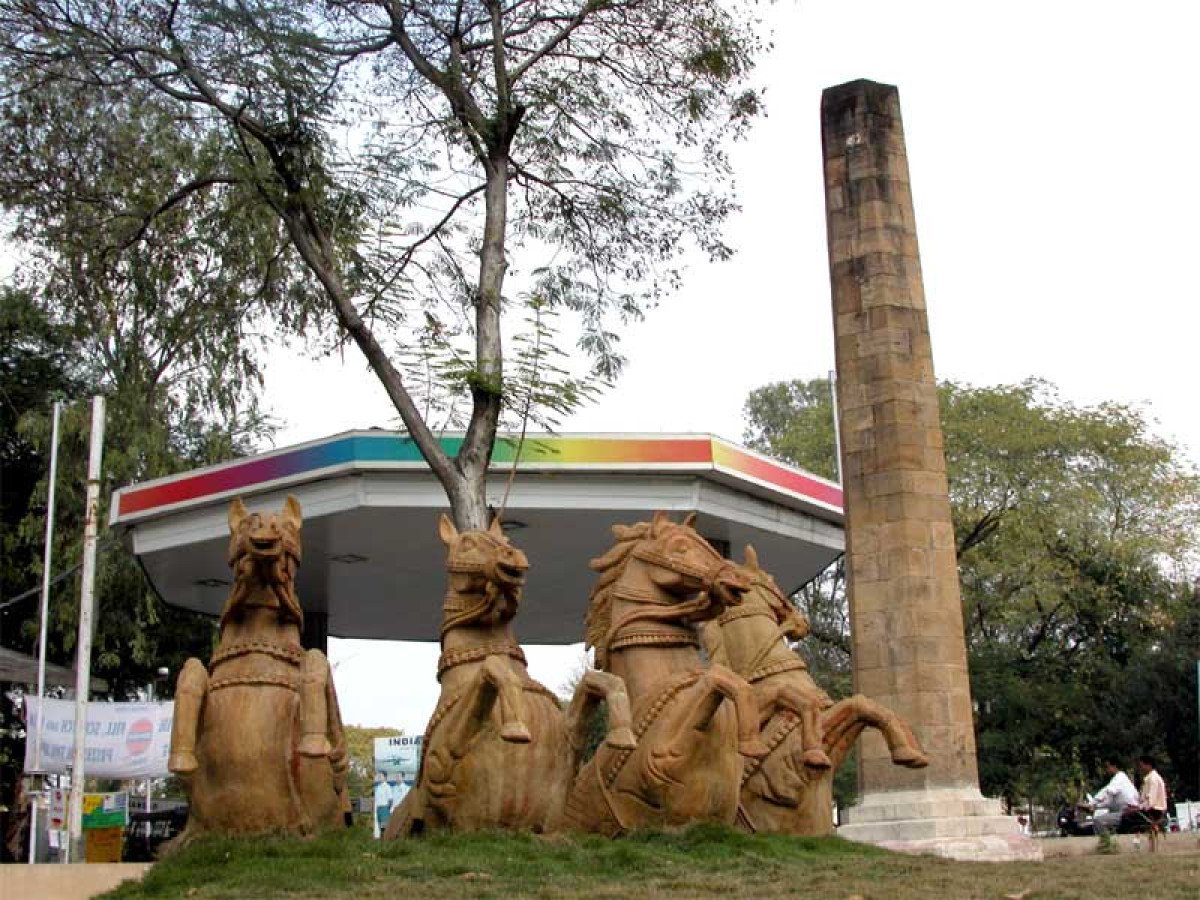
The Base of the Pillar and Horses: The most popular photo spot is at the base of the sandstone pillar, ensuring the full height of the pillar and at least two of the stucco horses are visible. This shot captures the symbolic heart of India.
Wit...The Base of the Pillar and Horses: The most popular photo spot is at the base of the sandstone pillar, ensuring the full height of the pillar and at least two of the stucco horses are visible. This shot captures the symbolic heart of India.
With the GTS Bench Mark: For the history enthusiast, a close-up photo of the smaller, original GTS Standard Bench Mark stone is a must, documenting the technical side of the historical survey.
Framed by the Vidhan Bhavan: The monument's proximity to the large Vidhan Bhavan (State Assembly) allows for a unique juxtaposition. Try a wide-angle shot that frames the historical monument against the backdrop of the modern seat of government, symbolizing the city's journey.
Night Illumination: If the monument is lit up at night, the evening lighting can provide a dramatic and aesthetically pleasing photo opportunity, highlighting the textures of the sandstone and the figures of the horses.Photo Gallery
Things To Do
-
Take a Symbolic Photo: The main activity is to take a photograph next to the sandstone pillar and the four horses. Standing at the symbolic center of India is a must-do for visitors, making for a unique and memorable travel photo.
Contemplate the History: Spend a few minutes reading the informational plaques (if available) to understand the monument's role in the Great Trigonometrical Survey of India and its connection to the British Raj's mapping efforts. Reflect on its immense historical significance.
Identify the Bench Mark: Actively look for the smaller, less obvious GTS Standard Bench Mark stone at the base of the main pillar. Understanding that this simple stone is the actual measurement point provides a deeper appreciation for the monument's scientific heritage.
Read More
Information
-
Why Famous:
Geographical Center of India: The monument's primary claim to fame is its symbolic designation as the geographical center of the Indian subcontinent. While the exact center may be contested by modern surveyors, it is historically significant as the point from which the Brit...Geographical Center of India: The monument's primary claim to fame is its symbolic designation as the geographical center of the Indian subcontinent. While the exact center may be contested by modern surveyors, it is historically significant as the point from which the British measured all distances across India, essentially placing Nagpur at the heart of their mapping project.
Legacy of the Great Trigonometrical Survey: It is a key physical artifact of the monumental Great Trigonometrical Survey of India (GTS), one of the most significant scientific and logistical achievements of the 19th and early 20th centuries. The monument stands as a tangible link to the ambitious colonial project that mapped the entire country.
Nagpur's Identity: The stone is central to Nagpur's identity, providing it with the unique sobriquet of "The Center of India. " This status makes it a mandatory stop for tourists and a source of local pride, reinforcing the city's strategic and historic importance. -
Architecture:
Colonial Monumental Architecture: The Zero Mile Stone is an example of early 20th-century colonial monumental architecture, designed for civic purpose and permanence. The structure is characterized by its simple, sturdy forms, primarily featuring a tall, circular, tapering ...Colonial Monumental Architecture: The Zero Mile Stone is an example of early 20th-century colonial monumental architecture, designed for civic purpose and permanence. The structure is characterized by its simple, sturdy forms, primarily featuring a tall, circular, tapering sandstone pillar resting on a square base. The design emphasizes strength and verticality to denote its importance.
The GTS Bench Mark and Pillar: The core of the monument is the GTS Standard Bench Mark, a smaller, unpolished stone that is the actual survey marker. The larger sandstone pillar acts as a protective and symbolic casing, indicating the elevation above sea level. This duality—the humble benchmark and the grand pillar—is the key architectural feature.
The Stucco Horse Statues: A later, more decorative addition is the set of four stucco horse statues placed at the base of the pillar. These statues are purely ornamental, symbolizing travel and distance, and adding a classical, artistic flourish to the otherwise utilitarian survey marker.
Dimension and Elevation: The pillar is substantial, standing tall in the small public space. The elevation inscribed on the top of the pillar is 1020. 171 feet above ASL, making the monument not just a marker of the center but also an elevation benchmark for the survey. -
How To Reach:
By Air: The Dr. Babasaheb Ambedkar International Airport (NAG) is approximately 10-12 KMS from the Zero Mile Stone. A taxi or app-based cab will take around 30 minutes to reach this very central landmark, which is close to the Vidhan Bhavan.
B... -
Near Tourist Places:
Sitabuldi Fort (1 KM), Raman Science Center (2 KMS), Shri Ganesh Mandir Tekdi (1. 5 KMS), Vidhan Bhavan (0. 5 KMS), Nagpur Junction Railway Station (2 KMS), Maharaj Bagh and Zoo (3 KMS), Deeksha Bhoomi (5 KMS), Sitabuldi Market (1 KM), Lata Mangeshkar Musical Garden (5 KMS), Ram Jhula (2. 5 KMS)
Tourism Tips
-
Health & Safety: The area is high-traffic, so be extremely careful while crossing roads. Since it's an open public place, maintain awareness of your surroundings. The monument itself is simple and safe, but avoid climbing on the pillar or the horses, as this is disrespectf...
Reviews
Nagpur Itineray And Cost:-
Information about New and Updated Locations() of Maharashtra Has Been Added :-
Card subtitle
Note:-
Information provided here in good Faith and for reference only.
All information and pictures will be updated soon, please keep visiting.
Near Places
Ambazari Lake & Garden
Some quick example text to build on the card title and make up the bulk of the card's content.
Go somewhere
Deeksha Bhoomi
Some quick example text to build on the card title and make up the bulk of the card's content.
Go somewhere
Dragon Palace Buddhist Temple
Some quick example text to build on the card title and make up the bulk of the card's content.
Go somewhere
Futala Lake
Some quick example text to build on the card title and make up the bulk of the card's content.
Go somewhere
Gandhi Sagar Lake
Some quick example text to build on the card title and make up the bulk of the card's content.
Go somewhere
Japanese Rose Garden
Some quick example text to build on the card title and make up the bulk of the card's content.
Go somewhere
Khekranala Lake & Dam
Some quick example text to build on the card title and make up the bulk of the card's content.
Go somewhere
Khindsi Lake
Some quick example text to build on the card title and make up the bulk of the card's content.
Go somewhere
Koradi Temple
Some quick example text to build on the card title and make up the bulk of the card's content.
Go somewhere
Lata Mangeshkar Musical Garden
Some quick example text to build on the card title and make up the bulk of the card's content.
Go somewherein Other Cities