General information
Photo Gallery
Things To Do
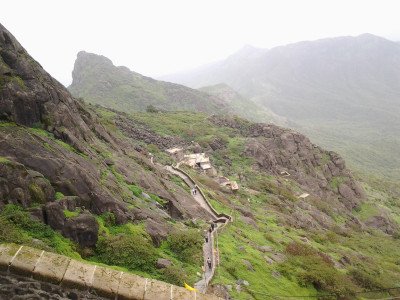
@@Introduction to Girnar: Girnar, also known as Girinagar or Revatak Parvata, is a group of sacred mountains considered older than the Himalayas, located near the city of Junagadh. It holds profound religious significance for both Hindus and Jains, making it one of the most important pilgrimage sites in Gujarat and India. The climb involves over 10,000 stone steps to reach the highest temples, representing a significant test of faith and endurance for devotees.@@Religious Significance for Hindus: For Hindus, the mountain is strongly associated with the Nath sect and Shiva devotees. The highest peak is home to the shrine of Dattatreya, a three-faced incarnation of the divine Trinity (Brahma, Vishnu, and Shiva), which attracts pilgrims seeking spiritual merit. The presence of the Bhavnath Mahadev Temple at the foothills marks the site of the annual Maha Shivratri Mela. The first peak houses the Amba Mata Temple, where newlyweds traditionally come to worship for a happy married life.@@Religious Significance for Jains: For Jains, Girnar is one of the five major Tirthas. It is considered the Nirvana Bhumi (salvation ground) of the 22nd Tirthankara, Lord Neminatha. A cluster of beautiful Jain temples, including the ancient Temple of Neminath built in the 11th century and the Mallinath Temple from 1177 AD, are situated about two-thirds of the way up the mountain. These temples are architectural marvels and draw followers from the Shwetambar and Digambar traditions.@@Geological and Natural Heritage: Geologically, Girnar is a complex formation of igneous rocks, offering a dramatic rise from the plains of Junagadh. It is surrounded by the dense Gir Forest, which is the exclusive habitat of the Asiatic Lion. The combination of lush greenery, ancient temples, and challenging topography makes the mountain range a unique hub of religious activity, trekking, and nature observation, providing a majestic backdrop to the city of Junagadh. The area's biodiversity is also a major draw, integrating the spiritual with the natural world.
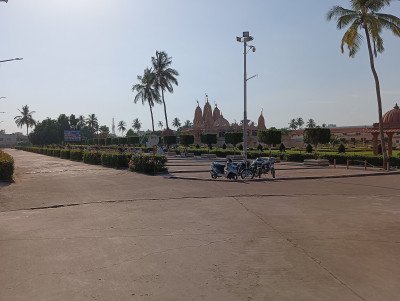
@@Establishment and History: The Shri Swaminarayan Mandir in Junagadh is a deeply significant and ancient shrine of the Swaminarayan Sampraday, personally ordered to be built by Bhagwan Swaminarayan (also known as Sahajanand Swami) himself. The foundation stone was laid in 1826 AD by Gunatitanand Swami, and the deities were installed by Swaminarayan on May 1, 1828, making it one of the earliest and most important temples in the sect. The land for this massive structure was generously donated by King Hemantsinh of Panchala. @@The Deities: The main sanctum houses the divine idols of Shri Ranchhodrai and Trikamrai. In the eastern wing, Radharaman Dev and Harikrishna Maharaj are worshipped, while the western side is dedicated to Siddheswar Mahadev, Parvati, and Ganesha. The temple is also known as Shri Radha Ramana Temple. @@Spiritual Significance: It is a paramount pilgrimage site, particularly because it marks the final resting place (Samadhi Sthan) of Gunatitanand Swami, the first spiritual successor and revered figure of the sect. This makes it a place of intense devotion and spiritual retreat, drawing thousands of followers from all over the world, especially during major festivals like Janmashtami and Holi. @@Atmosphere and Role: Beyond its religious function, the temple complex acts as a spiritual and cultural hub, maintaining a serene and disciplined atmosphere. It is a testament to the early spread of the Swaminarayan Sampraday in the Saurashtra region of Gujarat, continuing to uphold the spiritual and social teachings of Bhagwan Swaminarayan through daily rituals, aarti, and community service.
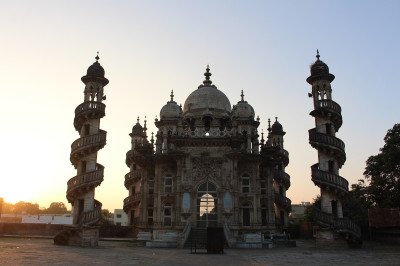
@@History and Purpose: The Mahabat Maqbara, which literally means the Mausoleum of Mahabat, is the grand resting place of Nawab Mahabat Khan II of Junagadh. Its construction was initiated by Mahabat Khan II in 1878 and was completed by his successor, Bahadur Khanji, in 1892. It stands as one of the most significant architectural legacies of the Nawab dynasty that ruled Junagadh until 1947. The complex also houses the adjacent, equally exquisite mausoleum of the Nawab's Wazir (Chief Minister), Bahauddinbhai Hasainbhai, which is often mistakenly grouped with the main maqbara.@@Architectural Fusion: The monument is famous worldwide for its utterly unique and elaborate architectural style, which is an audacious blend of Indo-Islamic and Gothic/European influences. This style, known as Indo-Saracenic or Indo-Gothic, was popular during the late 19th century under British influence but is executed here with a flair that is distinctively local. The intricate stone carvings, the elaborate arches, and the highly original minarets make it one of the most photographed and distinct buildings in Gujarat.@@Symbol of the Nawab's Era: The Maqbara is not just a tomb but a powerful symbol of the wealth, artistic patronage, and cultural fusion of the final decades of the Nawab rule. It represents a period of openness to European artistic ideas while maintaining a deep reverence for Islamic traditions. Despite the turbulent political context of the time, the building stands as an enduring monument to the grandeur and ambition of the local rulers of Junagadh.@@Present Day Status: Today, the Mahabat Maqbara is a protected heritage site, attracting architecture students, photographers, and general tourists. It is situated in a relatively busy area of the old city but maintains a surprising sense of quiet dignity within its compound walls. The main structure is well-maintained, but the smaller surrounding tombs and buildings in the compound show signs of age, providing a poignant contrast to the magnificence of the main mausoleum.

@@The Darbar Hall Museum is a grand repository of the 19th-century Nawabs' treasures, housed within the historic Taj Manzil building. This museum serves as a time capsule, preserving the opulent lifestyle of the Babi rulers who once governed the princely state of Junagadh. It exhibits approximately 2,900 artifacts, ranging from silver thrones and diamond-woven carpets to royal palanquins and howdahs. The museum is renowned for its vast collection of paintings, including a peculiar gallery dedicated to the last Nawab’s numerous pet dogs. Each room tells a story of the cultural fusion between Indian traditions and European influences that defined the era. Visitors can witness the "Darbar" or court setting, where the kings held their official meetings with high-ranking officials. The museum is a must-visit for history enthusiasts who wish to delve into the pre-independence royalty of Gujarat. It provides a comprehensive look at the weaponry, costumes, and daily objects used by the royal family, reflecting the wealth and artistic taste of the Nawabs. The museum is centrally located, making it an easy stop for tourists exploring the heart of the city.
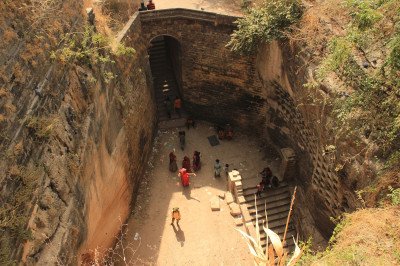
@@History and Founding: The Navghan Kuwo (or Navghan Kuva) is one of the oldest and most remarkable historical stepwells in Gujarat, located within the fortified walls of the ancient Uparkot Fort in Junagadh. It is believed to have been constructed in the 11th century during the reign of the Chudasama dynasty, possibly by Raja Navghan. Its primary function was to provide a crucial, perennial water source that could sustain the fort's inhabitants and military during long and protracted sieges, a testament to the strategic importance of water in medieval fortress defense.@@The Rock-Cut Engineering Marvel: What sets the Navghan Kuwo apart from most other stepwells (Vavs) in Gujarat is its unique construction method. It is largely hewn out of the soft rock of the plateau on which the fort stands. Unlike other wells that are structurally built up using masonry in excavated shafts, this one was carved directly into the bedrock. This rock-cut technique showcases the exceptional engineering skills of the 11th-century artisans and stonemasons, who managed to create a deep, spiral shaft within solid stone.@@Structural Features: The well descends to a depth of approximately 52 meters (?170 feet) to reach the permanent water table. The path down is a flight of narrow, spiraling stairs that encircle the shaft, a very uncommon design for stepwells, which usually feature linear paths and pillared landings. The deep well shaft is only partially lined with masonry, with the majority of the structure being the original carved rock, emphasizing its rugged, functional nature.@@Symbol of Endurance: The well is a powerful symbol of the fort's enduring resilience. Its ability to provide water in times of distress was the key factor that allowed the Uparkot Fort to withstand multiple, lengthy sieges by invading armies. Its name and legacy are intertwined with the history of the Chudasama kings and their military prowess, making it a critical historical landmark beyond its architectural merit.
@@The Junagadh Buddhist Cave Groups are not natural caverns but sophisticated rock-cut structures dating back to the 2nd century BCE. These caves are divided into three distinct groups: the Khapra Kodiya Caves, the Baba Pyare Caves, and the most famous Upperkot Caves. Carved during the reign of Emperor Ashoka and the Satavahanas, they served as monasteries (Viharas) and prayer halls (Chaityas) for Buddhist monks. The Upperkot group is particularly impressive, featuring a two-story structure with deep water tanks and beautifully carved pillars. The architecture reflects a transition from simple rock shelters to elaborate monastic complexes. These caves were strategically located near the ancient trade routes, making Junagadh a center for Buddhist learning and culture. The walls of the caves still bear faint inscriptions and decorative motifs that provide insights into the life of monks two millennia ago. Walking through these cool, shaded chambers offers a stark contrast to the bustling city outside. The caves are a testament to the religious tolerance of the region, where Buddhism once flourished alongside Hinduism and Jainism. They are an essential stop for anyone interested in archaeology and the ancient history of Western India.
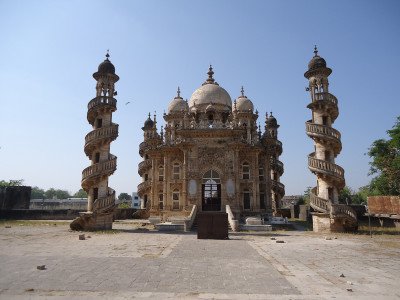
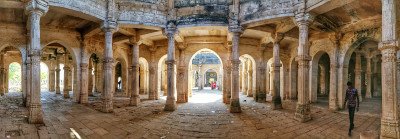
@@History and Conversion: The Jama Masjid in Junagadh is a historical building located within the ancient walls of the Uparkot Fort, a site that has seen centuries of changing political and religious rule. It is believed to have originally been a palace or a Hindu temple before its conversion into a mosque, a common historical practice in the region, which occurred during the time of the Sultans of Gujarat after the fort was captured from the local Chudasama rulers. Its current form dates largely from the 15th century and reflects the powerful military and architectural legacy of the Gujarat Sultanate.@@Architectural Significance: The mosque's structure is a fascinating blend of architectural elements, indicating its layered history. While it functions as a mosque with typical Islamic features like a large courtyard and prayer hall, its construction bears a resemblance to a fortified structure. The pillars inside the prayer hall are notably Hindu or Jain in origin, being re-used or converted from the earlier structure, which contributes to its unique aesthetic. The blend of Hindu/Jain pillar carvings with later Islamic arches and domes creates a distinct and powerful religious edifice within a military setting.@@Function and Importance: Today, the Jama Masjid is a protected monument, primarily functioning as a heritage site for tourists visiting the Uparkot Fort. While it is a place of worship, its historical and architectural value is its main draw. It symbolizes the cultural and political changes that swept across Junagadh over the centuries, standing as a tangible link between the Hindu/Jain rule of the Chudasama dynasty and the later Islamic rule of the Sultans and Nawabs. The sheer scale and antiquity of the structure make it a compelling stop within the fort's vast complex, offering a quiet, contemplative space amidst the ruins.@@A Center of Historical Power: Its location at the highest point of the city, inside the strategically important fort, emphasizes its role not just as a religious building but as a political and military asset. The mosque's presence inside the fort meant that the ruling power’s spiritual and temporal authority was physically manifested at the heart of the city's defenses, giving it a commanding view and a historical gravitas.
@@Historical Origin and Significance: Uparkot Fort is an ancient citadel with ramparts that are believed to date back to the Mauryan Empire, founded by Chandragupta around 319 BC. Its name literally means "upper fort" and it sits on a plateau in the middle of Junagadh. It served as a strategic defense point, witnessing and successfully withstanding an astonishing 16 sieges, with one legendary siege lasting 12 years. The fort has been modified and extended by subsequent rulers, including the Chudasama dynasty and the Solanki rulers, leaving a rich, layered history within its walls. @@The Ramparts and Cannons: In places, the defensive ramparts reach over 20 meters high. A key historical remnant is the massive, 17-foot-long and 4-foot 8-inch round bronze cannon known as "Nilam Top" or "Navghan Cannon", brought from Diu after the Ottoman Turks were defeated in the mid-16th century. The cannon symbolizes the fort's strategic military importance. @@Contents Within the Walls: The fort complex is not just a wall; it is a city in itself, housing several historical attractions, including the ancient Buddhist Caves (Khapara Kodiya Caves and Baba Pyare Caves), the Jama Masjid (a former palace or temple converted into a mosque), and two magnificent, rock-cut step-wells, the Adi Kadi Vav and Navghan Kuvo, all of which contribute to its status as a major archaeological site.
Information
Tourism Tips
Reviews
Junagadh-Gujarat-India Tourism:-
Information about New and Updated Locations(12+) of Has Been Added :-
Card subtitle
Note:-
Information provided here in good Faith and for reference only.
All information and pictures will be updated soon, please keep visiting.