
...

FAQs On Jor Mandir Complex

Bishnupur, West Bengal, India
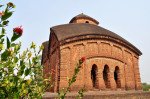
The Jor Mandir Complex, also known as Jor Bangla Temple or Keshto Ray Temple, is one of the most remarkable and well-preserved temples in Bishnupur. The name "Jor Bangla" translates to "twin thatched huts," which perfectly describes its unique architectural style. Built by Malla King Raghunath Singh a Dev II in 1655 CE, the temple is a prime example of the "do-chala" or "Bangla" style of architecture, where two thatched huts are joined together to form a single structure. The temple is dedicated to Lord Krishna and Radha. What makes this temple truly special is the incredible amount of detailed terracotta work that covers almost every inch of its surface, both inside and out. These plaques vividly depict scenes from the Ramayana, the Mahabharata, and the life of Lord Krishna, along with a variety of social scenes from the Malla period. The intricate storytelling through art is a key feature of the Jor Bangla Temple, offering a fascinating visual narrative of ancient epics and a glimpse into the society of the 17th century.

Ans:- The Jor Mandir Complex is a fascinating historical cluster located in the southern part of Bishnupur that comprises exactly three distinct, freestanding temples built close together within a beautifully maintained garden. The complex features two larger, symmetrically designed structures and one noticeably smaller temple positioned right between them. Despite the singular sound of the word "Jor," which typically means a pair, this specific complex forms a triad of individual shrines that collectively showcase excellent medieval engineering and style.

Ans:- The construction of the entire Jor Mandir Complex was commissioned in the year 1726 CE by the Malla King Gopal Singha Dev I, who ruled as the 55th monarch of the Mallabhum kingdom, alongside his devoted queen Dhvajamani Devi. This specific period was marked by an intense flourishing of Vaishnava religious culture and community devotion, during which the royal administration actively funded numerous stone and brick structures to secure their spiritual legacy and provide public spaces for mass worship.

Ans:- All three individual temples within the Jor Mandir Complex are built strictly in the classical "Ek-ratna" or single-pinnacled architectural sub-style, which is highly characteristic of medieval Bengal temple designs. This particular style features a square ground floor plan with gently sloping or curved roofs that mimic traditional regional bungalows, which are then surmounted by a single central shikhara or dome-like tower. This style perfectly combined structural stability with regional aesthetic tastes common during the Malla era.

Ans:- Unlike the brick-built Jor Bangla Temple, the structures within the Jor Mandir Complex were constructed almost entirely out of durable, locally quarried laterite stone blocks. Laterite was a highly abundant and robust material in the Bankura district, providing great structural longevity. To add fine artistic details, the rough laterite surfaces were originally covered with a thick layer of fine lime and stucco plaster, into which artisans carved elaborate decorative patterns, floral motifs, and narrative mythological scenes.

Ans:- The three laterite structures within the complex are arranged in a neat linear sequence running from north to south on independent raised stone platforms. In official documentation, the southern temple is labeled as Temple 1, the northern structure is labeled as Temple 2, and the smaller structure situated directly between them is designated as Temple 3. The two larger flanking temples feature highly similar dimensions, measuring roughly eleven meters square, while the middle temple is significantly smaller.

Ans:- The frontal facades of the temples in the Jor Mandir Complex are adorned with low-relief carvings executed directly into the laterite blocks and stucco coverings. While a large portion of the original delicate stucco work has unfortunately weathered away over the centuries, the remaining panels still beautifully illustrate complex narratives from ancient Hindu texts. Interestingly, the smaller central temple (Temple 3) remains the most heavily decorated structure externally, retaining a substantial amount of its detailed stucco ornamentation.

Ans:- The Jor Mandir Complex was constructed as a prominent center for Vaishnava worship, dedicated entirely to Lord Krishna and his various divine manifestations. The Malla kings were devout followers of Gaudiya Vaishnavism, and these shrines were designed to host idols and celebrate major religious festivals like Rash Yatra and Janmashtami. The walls themselves act as visual aids for devotees, presenting structural stories of Krishna's life, his playfulness with gopinis, and his ultimate cosmic victories.

Ans:- Each of the three temples features a perfectly square ground plan with varying heights. The southern structure (Temple 1) measures 11.8 meters in base length and reaches a height of 12.2 meters. The northern structure (Temple 2) closely mirrors this, measuring 11.7 meters in base length and 12.2 meters in height. The central smaller structure (Temple 3) is much more compact, built with a base length of 7 meters and a total height of 7.6 meters.

Ans:- Because laterite stone is naturally porous, coarse, and difficult to chisel into fine details compared to clay or sandstone, Malla artisans applied a specialized stucco coating over the stone blocks. This smooth plaster layer allowed craftsmen to execute incredibly fine, sharp, and delicate bas-reliefs that rivaled terracotta brickwork. The stucco coating also acted as a protective shield against the elements, though long-term monsoon exposure has caused significant peeling, revealing the raw laterite underneath today.

Ans:- Yes, the Jor Mandir Complex is officially designated as a Monument of National Importance under the protection and care of the Archaeological Survey of India (ASI) with reference number IN-WB-10. Furthermore, due to its outstanding universal value representing regional Indian architecture, the complex was added to the UNESCO World Heritage Site's Tentative List in the year 1998. The ASI manages continuous preservation efforts to arrest laterite decay and maintain the expansive surrounding gardens.

Ans:- The complex is situated in the southern archaeological zone of Bishnupur town, located approximately 600 meters west of the famous historical lake known as Lal Bandh. It lies in close proximity to the Radha Govinda Temple, which was built just 130 meters to the east by King Gopal Singha's son a few years later. The site is easily accessible by walking or taking a toto e-rickshaw from the main town center or from nearby major monuments.

Ans:- The remaining carvings on the laterite and stucco walls of the complex extensively illustrate epic battles, grand royal processions, and intense devotional scenes from the Ramayana and the Mahabharata. Visitors can observe panels depicting Lord Rama's exploits, the monkeys building the bridge to Lanka, specific sequences from the Puranas, and the multi-layered stories of the Krishna Leela, which showcase Krishna dancing, lifting the Govardhan hill, and defeating various demons sent by King Kamsa.

Ans:- The Jor Mandir Complex welcomes visitors every day from sunrise to sunset, with standard operational hours spanning from 6:00 AM to 6:00 PM. The early morning hours are highly recommended for visitors who wish to experience the serene atmosphere of the gardens without crowds, while the late afternoon provides soft, directional sunlight that perfectly illuminates the remaining laterite carvings, making it an ideal time for heritage enthusiasts and travel photographers.

Ans:- The Jor Mandir Complex is incredibly important because it represents the peak maturity of the stone-based Ek-ratna architectural style developed by the Malla dynasty. While early Bishnupur structures relied heavily on imported or local bricks, the successful execution of three massive laterite stone shrines shows a clear evolution in regional masonry and structural engineering. It stands as a perfect textbook example of how local folk traditions were systematically translated into permanent stone monuments.

Ans:- Yes, the Jor Mandir Complex is surrounded by several other major historical sites within short walking distance, making it a convenient stop on a broader Bishnupur tour. Right next to it lies the beautiful Radha Govinda Temple, and the massive historical reservoir Lal Bandh is just a short distance away. Tourists can easily combine their visit to Jor Mandir with the nearby Kalachand Temple and Nandalal Temple, creating a comprehensive circuit of laterite shrines.
Information about New and Updated Locations() of West Bengal Has Been Added :-
Card subtitle

Note:-

Information provided here in good Faith and for reference only.

Near Places
...
Acharya Jogesh Chandra Museum

Some quick example text to build on the card title and make up the bulk of the card's content.

Go somewhere

...
Big Stone Gateway

Some quick example text to build on the card title and make up the bulk of the card's content.

Go somewhere

...
Bishnupur Mela Ground

Some quick example text to build on the card title and make up the bulk of the card's content.

Go somewhere
...
Bishnupur Rajbari

Some quick example text to build on the card title and make up the bulk of the card's content.

Go somewhere
...
Chhinnamasta Temple

Some quick example text to build on the card title and make up the bulk of the card's content.

Go somewhere

...
Dalmadal Cannon

Some quick example text to build on the card title and make up the bulk of the card's content.

Go somewhere

...
Garh Darwaja

Some quick example text to build on the card title and make up the bulk of the card's content.

Go somewhere
...
Gokul Chand Temple

Some quick example text to build on the card title and make up the bulk of the card's content.

Go somewhere

...
Hadal-Narayanpur

Some quick example text to build on the card title and make up the bulk of the card's content.

Go somewhere
...
Jhilimili & Sutan Forest

Some quick example text to build on the card title and make up the bulk of the card's content.

Go somewhere
...
Jor Bangla Temple

Some quick example text to build on the card title and make up the bulk of the card's content.

Go somewhere
...
Jor Mandir Complex

Some quick example text to build on the card title and make up the bulk of the card's content.

Go somewhere
...
Jorbangla Temple

Some quick example text to build on the card title and make up the bulk of the card's content.

Go somewhere
...
Joypur Forest

Some quick example text to build on the card title and make up the bulk of the card's content.

Go somewhere
...
Kalachand Temple

Some quick example text to build on the card title and make up the bulk of the card's content.

Go somewhere
...
Kamarpukur

Some quick example text to build on the card title and make up the bulk of the card's content.

Go somewhere
in Other Cities