...

FAQs On Pathar Darwaja

Bishnupur, West Bengal, India
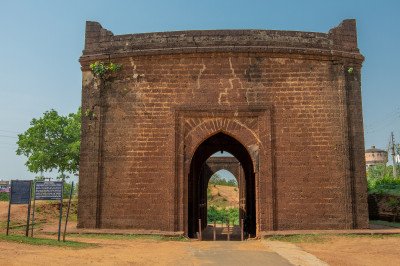
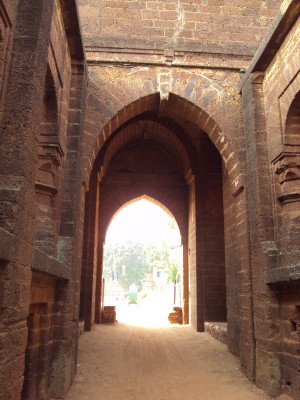
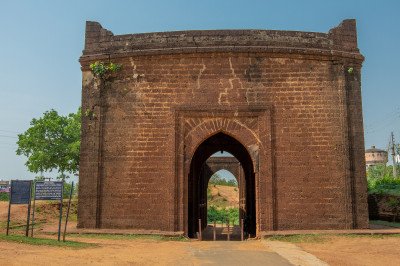
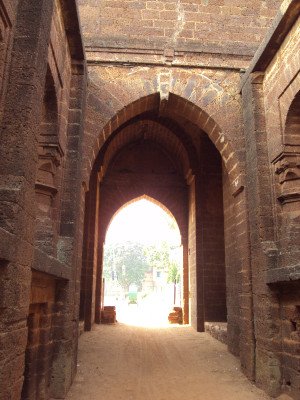
The Pathar Darwaja (Stone Gateway), also officially known as the Garh Darwaja, is one of the most imposing non-religious monuments in Bishnupur. It served as the crucial northern entrance to the formidable citadel, or Fort (Garh), of the Malla Kings. This massive arched gateway, built entirely of du rable laterite stone blocks, stands as a stark reminder that Bishnupur was not just a religious center but also a strategic military capital (Mallabhum). Its construction is attributed to the powerful Malla King, Bir Singha Dev, in the second half of the 17th century (circa 1670 CE), a time when the kingdom was still strong but beginning to feel the military pressures from external forces. Unlike the terracotta temples which are rich in fine carving, the Pathar Darwaja is purely utilitarian and defensive. Its power is conveyed through its sheer scale, robust material, and design features tailored for military defense. The central arched passage is flanked by double-storeyed chambers, designed to house troops and guards. These chambers are fitted with narrow slitsarrow slitsfrom which archers and gunmen could fire upon approaching enemies while remaining protected. It is a symbol of the Malla King's engineering prowess in utilizing the locally abundant, reddish laterite stone for massive, enduring constructions, serving as a tangible link between the peaceful piety of the temples and the martial power of the kingdom.

Ans:- The Pathar Darwaja, also known as the Garh Darwaja or Stone Gateway, served as the primary northern entrance to the fortified city of Bishnupur. Constructed during the reign of the Malla kings, likely by King Bir Singha Dev in the 17th century, it acted as a vital defensive structure for the citadel. This gateway was part of a complex system of fortifications, including ditches and ramparts, designed to protect the royal palaces and the town from external threats. Today, it remains one of the most imposing non-religious monuments, representing the strategic military architecture of that era.

Ans:- The name "Pathar Darwaja" translates to "Stone Gateway" in Bengali, a direct reference to the materials used in its construction. Unlike many other structures in the region that utilized a combination of clay bricks and terracotta, this gateway was constructed primarily using dressed laterite blocks, which were abundant in the Bankura district. The use of solid stone blocks made the gateway exceptionally durable and formidable, fitting for its purpose as a high-security entrance to the royal fort, and it remains a striking example of military engineering from the medieval period in West Bengal.

Ans:- Scholarly consensus and local tradition attribute the construction of the Pathar Darwaja to King Bir Singha Dev, the 52nd ruler of the Malla dynasty, who reigned from 1656 to 1682 CE. He was responsible for significantly enhancing the defensive capabilities of Bishnupur. The gate was built to provide a secure point of entry for the capital's citadel. The architecture reflects the period's military requirements, with features like double-storied galleries for troops and narrow slits in the walls for firing weapons, showcasing the king's foresight in securing his kingdom's borders.

Ans:- The Pathar Darwaja was designed with several sophisticated defensive features. It included double-storied galleries flanking the central passage, which were specifically intended to accommodate troops stationed to guard the entrance. Furthermore, the walls featured narrow, rectangular apertures known as arrow-slits or gun-slits. These allowed soldiers to safely fire arrows or muskets at approaching enemies from inside the fort while remaining protected behind the thick laterite walls. These structural details emphasize that the gate was not merely an ornamental entrance but a functional military stronghold capable of repelling intruders during times of conflict.

Ans:- Yes, there is a smaller gateway known as "Choto Darwaja" located about 80 meters northwest of the main Pathar Darwaja (or Garh Darwaja). While the Pathar Darwaja was the main, grander northern entrance, the Choto Darwaja served as an auxiliary entry point to the city. Its construction is slightly different, using a mix of laterite blocks in the lower half and brick with stucco on the upper portion. Both gates are remnants of the intricate defense systems that once protected the capital, and today, they stand as the sole survivors of the fort's original extensive defensive network.

Ans:- The primary material used for the Pathar Darwaja is dressed laterite, a type of iron-rich soil-derived stone that is very common in the Bankura region. Laterite is known for being soft when quarried but hardening significantly upon exposure to air, making it an excellent and durable building material for fortresses and heavy structures. The gate's construction demonstrates the skillful use of this local stone by Malla artisans, who shaped these large blocks to build a sturdy, long-lasting fortification that has withstood the elements for several centuries without significant structural decay.

Ans:- Yes, historical evidence suggests that both the Pathar Darwaja and the Choto Darwaja were protected by water-filled ditches, known as "bandhs," which acted as moats. These ditches would have been crossed by mobile structures, such as floating or drawbridges, which could be removed quickly in the event of an emergency or invasion. These water bodies were not only strategic defensive assets but also served the dual purpose of water storage for the city, reflecting the Malla rulers' intelligent approach to urban planning, resource management, and regional security for their capital.

Ans:- While exact height measurements can vary due to ground levels and structural erosion over time, the Pathar Darwaja is a two-storied structure that was designed to be tall enough to allow the passage of soldiers and possibly horses or light transport while providing an elevated platform for archers and gunners. The gate's design is focused on imposing strength rather than height alone. The lower section represents the original gateway phase, while the taller, additional gateway section was added adjacent to the first, creating a multi-layered defensive passage that spans a significant vertical space.

Ans:- Generally, tourists are not permitted to climb to the top of the Pathar Darwaja for safety and preservation reasons. The structures are ancient, and the stability of the upper levels is a concern for the Archaeological Survey of India. While some parts of these historic gates might have had staircases in the past, access to these areas is typically restricted to maintain the integrity of the monument. It is best to admire the impressive craftsmanship and the defensive architectural design from the ground level, where you can see the gun-slits and the scale of the laterite blocks clearly.

Ans:- The Pathar Darwaja is located in the northern part of Bishnupur, relatively close to other major heritage sites. For example, it is situated approximately 300 meters north of the famous Jor-Bangla (Kesto-Rai) Temple. Because Bishnupur's heritage zone is quite concentrated, visitors can easily walk or take a short rickshaw ride between the Pathar Darwaja and nearby temples like the Madanmohan Temple or the Rasmancha. This proximity makes it very convenient for tourists to plan a comprehensive itinerary that covers both the religious terracotta temples and the secular defensive structures in a single day.

Ans:- Yes, the Pathar Darwaja is part of a larger historical circuit in Bishnupur. Nearby attractions include the Choto Darwaja, which is just a short distance away, as well as the renowned Jor-Bangla Temple, Rasmancha, and the Madanmohan Temple. You can also visit the Acharya Jogesh Chandra Museum, which houses various artifacts from the Malla period. Because these sites are all within the town, they are easily accessible. Most visitors choose to hire a local guide or rent a cycle-rickshaw for the day to see all these monuments, as they provide a comprehensive view of the Malla kingdom's history.

Ans:- Usually, there is no separate, hefty entry fee to view the Pathar Darwaja as it is an open-air historical gateway located in the vicinity of public roads. However, if it is part of a larger protected complex managed by the Archaeological Survey of India (ASI) under a combined heritage ticket for Bishnupur, you might need to show a pass. It is always best to check at the main tourist kiosk or the entry point of the town's primary monument complexes, as policies can change periodically regarding entry fees for specific monuments and heritage zones.

Ans:- The Archaeological Survey of India (ASI) periodically monitors and performs maintenance on the Pathar Darwaja to ensure its stability and to protect it from further weathering. While there may not always be active, large-scale construction, minor conservation efforts, such as cleaning the laterite blocks or clearing vegetation that can damage the stone, are common. Visitors should respect any cordoned-off areas if maintenance is underway. These preservation efforts are crucial because the gateway is a vital piece of Bengal's military history and a rare surviving example of a Malla-era fortification gate.

Ans:- The best season to visit the Pathar Darwaja and other heritage sites in Bishnupur is during the winter months, from October to March. During this time, the weather is pleasant and cool, making it comfortable to walk around the open-air sites for several hours. Summers can be extremely hot and humid in Bankura, which makes exploring the outdoor monuments challenging. The monsoon season also brings heavy rainfall, which might make the area slippery and hinder outdoor sightseeing, so planning your trip for the cooler, drier months will ensure a much more enjoyable and comfortable exploration of the historical landmarks.

Ans:- Yes, you can easily find local guides in Bishnupur who are well-versed in the history of the Pathar Darwaja. These guides are often found near major tourist spots or can be arranged through your hotel or the local tourism office. Engaging a guide is highly recommended for this site, as they can explain the specific defensive tactics used by the Malla kings, the significance of the arrow-slits, and the historical context of the fort's layout. Their insights can bring the cold stone structure to life, helping you appreciate the strategic importance it held in 17th-century Bengal.
Information about New and Updated Locations() of West Bengal Has Been Added :-
Card subtitle

Note:-

Information provided here in good Faith and for reference only.

Near Places
...
Acharya Jogesh Chandra Museum

Some quick example text to build on the card title and make up the bulk of the card's content.

Go somewhere

...
Big Stone Gateway

Some quick example text to build on the card title and make up the bulk of the card's content.

Go somewhere

...
Bishnupur Mela Ground

Some quick example text to build on the card title and make up the bulk of the card's content.

Go somewhere
...
Bishnupur Rajbari

Some quick example text to build on the card title and make up the bulk of the card's content.

Go somewhere
...
Chhinnamasta Temple

Some quick example text to build on the card title and make up the bulk of the card's content.

Go somewhere
...
Dalmadal Cannon

Some quick example text to build on the card title and make up the bulk of the card's content.

Go somewhere
...
Garh Darwaja

Some quick example text to build on the card title and make up the bulk of the card's content.

Go somewhere
...
Gokul Chand Temple

Some quick example text to build on the card title and make up the bulk of the card's content.

Go somewhere

...
Hadal-Narayanpur

Some quick example text to build on the card title and make up the bulk of the card's content.

Go somewhere
...
Jhilimili & Sutan Forest

Some quick example text to build on the card title and make up the bulk of the card's content.

Go somewhere
...
Jor Bangla Temple

Some quick example text to build on the card title and make up the bulk of the card's content.

Go somewhere
...
Jor Mandir Complex

Some quick example text to build on the card title and make up the bulk of the card's content.

Go somewhere
...
Jorbangla Temple

Some quick example text to build on the card title and make up the bulk of the card's content.

Go somewhere
...
Joypur Forest

Some quick example text to build on the card title and make up the bulk of the card's content.

Go somewhere
...
Kalachand Temple

Some quick example text to build on the card title and make up the bulk of the card's content.

Go somewhere
...
Kamarpukur

Some quick example text to build on the card title and make up the bulk of the card's content.

Go somewhere
in Other Cities