

Sanchi
General information
-
Ideal Duration:
1 DayPlace Type:
UNESCO World Heritage, ReligiousEntry Fees:
Indian Citizen Fee: The entry fee for Indian visitors is approximately 40 rupees. This is very affordable given the scale and historical importance of the site. Children below 15 years usually have free entry.
Foreigner Entry Fee: For inte...Indian Citizen Fee: The entry fee for Indian visitors is approximately 40 rupees. This is very affordable given the scale and historical importance of the site. Children below 15 years usually have free entry.
Foreigner Entry Fee: For international tourists, the entry fee is around 600 rupees. This includes access to the main stupa complex and the archaeological museum. Digital payments are preferred at the ticket counter.Timing:
Standard Visiting Hours: The Sanchi Stupa complex is open from sunrise to sunset, usually 6:30 AM to 6:30 PM. The Archaeological Museum is open from 10:00 AM to 5:00 PM (closed on Fridays). Plan your visit to reach the hill by early morning for the best light.Standard Visiting Hours: The Sanchi Stupa complex is open from sunrise to sunset, usually 6:30 AM to 6:30 PM. The Archaeological Museum is open from 10:00 AM to 5:00 PM (closed on Fridays). Plan your visit to reach the hill by early morning for the best light.
Best Time for Photos: The first two hours after sunrise and the last hour before sunset are the "golden hours. " The carvings on the gateways become more prominent under the soft, angled light. Avoid the midday sun as it can be very harsh on the open hillock.Special Events:
Chethiyagiri Vihara Festival: This is the most important annual event held in November. The relics of Buddha's disciples, Sariputta and Mahamoggallana, are displayed for public viewing. Thousands of devotees from Sri Lanka and Japan attend this ceremony. It is a deeply sp...Chethiyagiri Vihara Festival: This is the most important annual event held in November. The relics of Buddha's disciples, Sariputta and Mahamoggallana, are displayed for public viewing. Thousands of devotees from Sri Lanka and Japan attend this ceremony. It is a deeply spiritual and colorful event for the town.
Full Moon Night Views: Occasionally, the site is open for night viewing during special full moon nights. The white stone of the stupas glows under the moonlight. It is a mystical experience that attracts many photographers and spiritual seekers.Best Photo Spots:
South Gateway Perspective: This is the most popular spot for a full view of the Great Stupa. The gateway and the dome align perfectly for a symmetrical shot. Early morning light provides the best shadows for the carvings.
Monastery Ruins: ...South Gateway Perspective: This is the most popular spot for a full view of the Great Stupa. The gateway and the dome align perfectly for a symmetrical shot. Early morning light provides the best shadows for the carvings.
Monastery Ruins: The ruins of the ancient monasteries provide a great backdrop for wide-angle shots. The green grass contrasting with the red and brown stone is very scenic. It captures the essence of a lost civilization beautifully.Photo Gallery
Things To Do
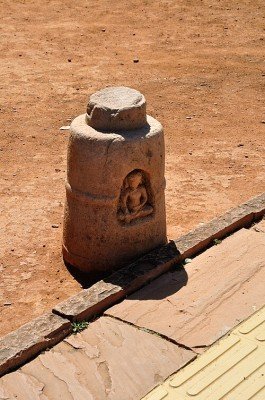 Boar Rock, also known as Shelter III F-19, is one of the most iconic rock shelters within the Bhimbetka site. It is named after a spectacular, oversized painting of a wild boar that dominates the rock face. This painting is unique because of its scale and the mythical appearance of the creature, which features elements of an elephant and a bull. The boar is depicted in a deep red pigment, likely derived from haematite, and is shown in a dynamic pose that suggests power and movement. Archaeologists believe this creature might represent a prehistoric deity or a legendary beast from tribal folklore. Surrounding the giant boar are smaller figures of humans and animals, creating a narrative of a hunt or a ritual. The shelter itself provides excellent natural protection, which has helped preserve the vividness of the colors for thousands of years. It serves as a testament to the artistic vision of early humans who utilized natural rock contours to enhance their drawings.
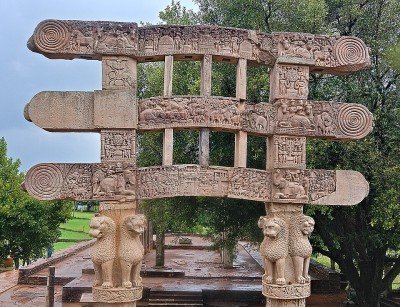 @@Narrative and Historical Theme: The Southern Gateway is considered to be the first of the four Toranas to be constructed (circa 1st century BCE), making it the oldest. It was erected right in front of the main staircase of Stupa No. 1, confirming its role as the principal ceremonial entrance. The primary narrative on this gateway focuses on the events surrounding the Buddha’s birth (Nativity) and his early life, including the story of the Vulture’s Peak and the visit of Emperor Ashoka to the Ramagrama Stupa. @@Condition and Patronage: Although it was the first, it is the most heavily restored, particularly by Major Cole in the late 19th century, with parts of the right column being new. However, the original stone carvings provide a crucial glimpse into the earliest phase of Satavahana sculpture at Sanchi. The carving style here is comparatively rigid and slightly less refined than the later gates, reflecting the initial, formative period of stone carving skill transfer from wood/ivory. @@Inscription: The middle architrave is inscribed with the name of Balamitra, the pupil of Aya Cuda, a preacher of the law, indicating the contribution of both artisans and the Buddhist community.
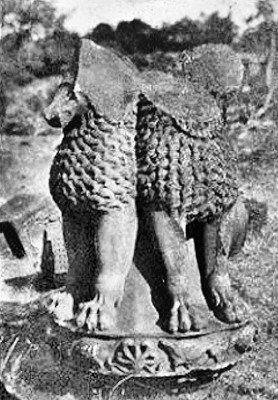 @@Historical Significance of the Pillar: The Ashoka Pillar is one of the most famous of the pillars erected by Emperor Ashoka in the 3rd century BCE to spread the message of Buddhism and his edicts (the Schism Edict). Originally, the complete pillar, including the famous four-lion capital, stood here. Its presence indicates that the Great Stupa was a central religious site from the very start of the Mauryan Empire. It represents the height of Mauryan art and engineering, showcasing a monolithic shaft made of polished Chunar sandstone. This highly polished finish, known as 'Mauryan Polish,' is a distinctive and sophisticated feature that has lasted over two millennia. @@Present Condition and Display: Today, only the lower, broken shaft remains at its original site near the Southern Gateway. The magnificent capital, consisting of the four back-to-back lions (which is the basis for the National Emblem of India), is now preserved and displayed at the nearby Sanchi Museum (ASI). The Schism Edict inscription on the pillar warned monks and nuns against creating divisions (schism) within the Buddhist Sangha. The pillar is a testament to the powerful administrative and religious zeal of Ashoka and the technical expertise of his artisans.
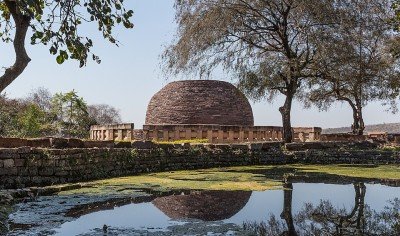 Stupa No. 2, located further down the western slope of the hill, is architecturally simpler than the Great Stupa but holds immense significance for its unique decorative stone railing, which is considered to contain the earliest extensive stone reliefs in India dating back to around 115 BCE (Shunga period): Unlike the narrative panels of Stupa 1's gateways, the medallions on the railing of Stupa 2 feature predominantly non-narrative, often non-Buddhist motifs, including animals, flowers, and auspicious symbols, but also the first known stone depiction of some Jataka tales.: This stupa is believed to house the relics of ten high-ranking Arhats (disciples of the Buddha), and its lower position on the hill compared to Stupa 1 and Stupa 3 may signify the slightly lesser spiritual status of its enshrined relics.: Its early dating makes it a vital link in the evolutionary chain of Indian art and the transition from wooden prototypes to stone carvings.:
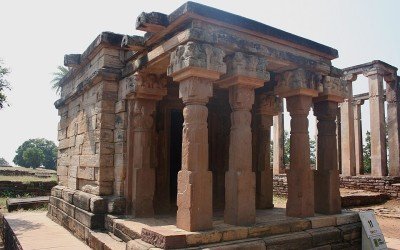 @@Historical Significance: Temple No. 17 is arguably one of the most important landmarks in the history of Indian temple architecture. Dating back to the 5th century CE during the reign of the Gupta Empire, it is considered one of the earliest surviving examples of structural temples in India. Before this era, religious worship often took place in rock-cut caves (Chaityas) or around Stupas. This temple marks the transition to building permanent, dedicated stone 'houses of god' for Hindu deities, influencing nearly all subsequent temple styles across the subcontinent. @@Architectural Purity: Its significance lies in its incredible simplicity and structural purity. It consists of a simple, square sanctum (Garbagriha) with a flat roof and a pillared portico (mandapa) in the front. This basic design established the template for the classical Indian temple structure. The builders used well-cut stone blocks assembled without mortar, relying on precise fitting, demonstrating the technical maturity of the Gupta age. Though found in a Buddhist complex, its form is a perfect model for early Hindu temples.
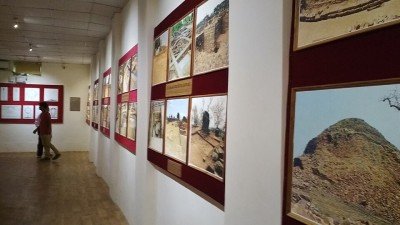 The Sanchi Archaeological Museum, established by Sir John Marshall in 1919, is one of the most important site museums in India. It houses a vast collection of artifacts recovered during the excavation and restoration of the Sanchi monuments. The museum is divided into four main galleries and a central hall, each showcasing different periods of Indian history from the Mauryan to the Medieval eras. The highlight of the museum is undoubtedly the original Lion Capital of the Ashoka Pillar, which served as the inspiration for India's National Emblem. Other significant exhibits include stone sculptures of the Buddha, Yakshini figures, and various household objects used by the monks who lived on the hill. The museum provides the necessary context to understand the ruins on the hilltop, explaining the symbols and stories depicted on the gateways. It is a quiet, air-conditioned space that offers a welcome break from the sun while providing a deep dive into the artistic and spiritual heritage of the region.
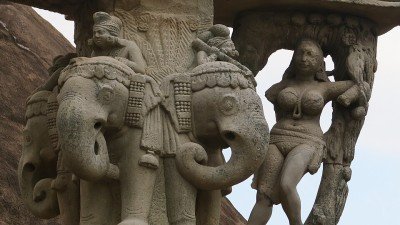
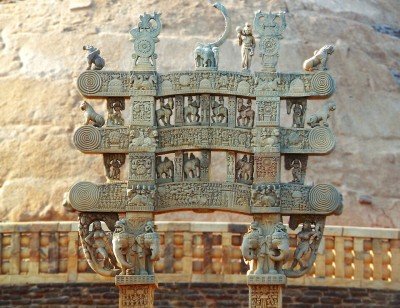 @@Narrative and Artistic Theme: The Northern Gateway is widely regarded as the best preserved of the four Toranas, retaining much of its original structure and intricate detail. Its carvings focus heavily on the Miracles of the Buddha (such as the miracle of Sravasti and the temptation by Mara) and the popular Vessantara Jataka (a tale of the Buddha’s boundless charity in a previous life). The detail is so fine that one can see the daily life and landscape of ancient India within the reliefs. @@Condition and Significance: The gateway's excellent condition allows for a comprehensive study of the Satavahana sculpture style (1st century BCE/CE). Unlike the Southern Gateway, which was the first and more rigid, the Northern one displays a maturity and dynamism in its narrative, with figures being more rounded and complex. The gateway is topped by four majestic elephants, which form the capital of the pillars, distinguishing it from the lion or yaksha capitals of the other gates. @@Iconography: It prominently features the aniconic representations of the Buddha, using the empty throne, the Dharma Chakra (Wheel of Law), and the Bodhi Tree.Show All
 @@Place Details: The Heliodorus Pillar, locally known as Khamba Baba, is one of the most historically significant monuments in India, representing a bridge between ancient Greek and Indian civilizations. Erected around 113 BCE, it is a stone column dedicated by Heliodorus, a Greek ambassador from Taxila who was sent to the court of the Shunga King Bhagabhadra. What makes this pillar extraordinary is the inscription in Brahmi script, which identifies Heliodorus as a "Bhagavata" or a follower of Vishnu. This is the earliest archaeological evidence of a foreigner converting to Vaishnavism, proving the deep cultural and religious exchange that existed over two thousand years ago. The site was originally part of a large temple complex dedicated to Vasudeva, though only the pillar and some foundations remain today. The pillar stands in a quiet, rural setting near the confluence of the Bes and Betwa rivers. For centuries, it was covered in vermillion by local villagers who worshipped it as a deity named Khamba Baba, unaware of its Greek origins until it was rediscovered by Sir Alexander Cunningham in 1877. The pillar's survival through millennia is a testament to the durability of Indian stone craftsmanship and the respect for sacred spaces. Today, it serves as a pilgrimage site for history enthusiasts and spiritual seekers alike, offering a serene atmosphere far from the crowded tourist trails. The surrounding area of Besnagar is also rich in archaeological potential, with many mounds yet to be fully excavated. A visit to the pillar provides a unique insight into the religious syncretism of ancient India, where borders were fluid and ideas traveled across continents.
Information
-
Why Famous:
World-Famous Toranas: Sanchi is iconic for its four ceremonial gateways that are masterpieces of Buddhist art. Each gateway is carved with such detail that they look like ivory work on stone. They are the most photographed structures in the entire site. These Toranas have...World-Famous Toranas: Sanchi is iconic for its four ceremonial gateways that are masterpieces of Buddhist art. Each gateway is carved with such detail that they look like ivory work on stone. They are the most photographed structures in the entire site. These Toranas have influenced temple architecture across Asia.
Ancient Ashoka Pillar: The fragments of the famous Ashoka Pillar can be found here. It is famous for its polished surface and the four-lion capital which is the national emblem of India. The pillar represents the power and the spiritual reach of the Mauryan Empire. It is a significant site for understanding India's national identity. -
Architecture:
Mauryan and Shunga Design: The architecture of the Great Stupa is a masterpiece of early stone construction. It consists of a hemispherical dome representing the sky. The dome is crowned by a triple umbrella symbolizing the Three Jewels of Buddhism. The most striking feat...Mauryan and Shunga Design: The architecture of the Great Stupa is a masterpiece of early stone construction. It consists of a hemispherical dome representing the sky. The dome is crowned by a triple umbrella symbolizing the Three Jewels of Buddhism. The most striking features are the four intricately carved gateways called Toranas. These gateways depict Jataka tales and events from Buddha's life.
Dimensions and Structure: The Great Stupa has a diameter of 36. 6 meters and a height of 16. 46 meters. The stone railings surrounding the base were added later during the Shunga period. Each Torana stands about 10 meters high and is covered in detailed stone reliefs. The precision of the carvings on hard sandstone is a marvel of ancient engineering. -
How To Reach:
By Air Access: The nearest airport is Raja Bhoj Airport in Bhopal, about 55 KMS away. You can hire a pre-paid taxi from the airport to reach Sanchi in about 1. 5 hours. Several domestic flights connect Bhopal to major Indian metros.
By Train C...By Air Access: The nearest airport is Raja Bhoj Airport in Bhopal, about 55 KMS away. You can hire a pre-paid taxi from the airport to reach Sanchi in about 1. 5 hours. Several domestic flights connect Bhopal to major Indian metros.
By Train Connectivity: Sanchi has its own small railway station, but only a few passenger trains stop here. The better option is to take a train to Vidisha (10 KMS) or Bhopal (46 KMS). From there, local buses and taxis are frequently available to reach the monuments.
By Road Route: Sanchi is located on the main road connecting Bhopal and Sagar. State transport buses run frequently between these cities. Driving from Bhopal is a pleasant journey through the rural landscape of Madhya Pradesh.
Local Transportation: Once at the base of the hill, you can walk up or take a local auto-rickshaw. The site itself is best explored on foot. There are battery-operated vehicles available for elderly visitors or those with mobility issues to reach the top. -
Weather and Best Time to Visit:
Winter Exploration: October to March is the peak season for visiting Sanchi. The weather is cool and pleasant, making the walk up the hill comfortable. You can spend the whole day exploring without getting tired by the heat.
Monsoon Charm:...Winter Exploration: October to March is the peak season for visiting Sanchi. The weather is cool and pleasant, making the walk up the hill comfortable. You can spend the whole day exploring without getting tired by the heat.
Monsoon Charm: July to September brings out the green side of the Raisen district. The moss-covered stones and the misty atmosphere add a romantic feel to the ruins. However, be prepared for occasional heavy rain showers. -
Near Tourist Places:
1. Vidisha (10 KMS), 2. Udayagiri Caves (14 KMS), 3. Bhopal (46 KMS), 4. Bhimbetka (90 KMS), 5. Raisen Fort (25 KMS), 6. Gyaranaspur (45 KMS), 7. Islamnagar (55 KMS), 8. Bhojpur (75 KMS), 9. Sagar (160 KMS), 10. Indore (240 KMS)
Tourism Tips
-
Health and Sun Protection: Since the stupa complex is in an open area, carry an umbrella or wear a hat. Use sunscreen to protect yourself from the afternoon sun. Drinking water is available, but carrying your own bottle is recommended for convenience.
Read MoreHealth and Sun Protection: Since the stupa complex is in an open area, carry an umbrella or wear a hat. Use sunscreen to protect yourself from the afternoon sun. Drinking water is available, but carrying your own bottle is recommended for convenience.
Packing Guide: Wear comfortable walking shoes as the site involves a lot of uphill walking. Carry a small backpack with essentials like a power bank and some snacks. Dress modestly as it is a religious site for many visitors.
Accommodation Tips: While there are a few guesthouses in Sanchi, staying in Bhopal offers more variety. Bhopal has luxury hotels as well as budget options. If you want to see the sunrise, staying at the MP Tourism Gateway Retreat in Sanchi is the best choice.
Safety and Guides: Hire an authorized guide from the entrance to understand the complex history. Beware of unauthorized "guides" who might give incorrect information. The area is generally very safe for solo female travelers and families.Reviews
FAQs
Sanchi Itineray And Cost:-
Other Places In Madhya Pradesh :-
Other States In India :-
Information about New and Updated Locations() of Madhya Pradesh Has Been Added :-
Card subtitle
Note:-
Information provided here in good Faith and for reference only.
Near Places
Amarkantak
Some quick example text to build on the card title and make up the bulk of the card's content.
Go somewhere
Bhedaghat
Some quick example text to build on the card title and make up the bulk of the card's content.
Go somewhere
Bhopal
Some quick example text to build on the card title and make up the bulk of the card's content.
Go somewhere
Burhanpur
Some quick example text to build on the card title and make up the bulk of the card's content.
Go somewhere
Chanderi
Some quick example text to build on the card title and make up the bulk of the card's content.
Go somewhere
Chitrakoot
Some quick example text to build on the card title and make up the bulk of the card's content.
Go somewhere
Gwalior
Some quick example text to build on the card title and make up the bulk of the card's content.
Go somewhere
Indore
Some quick example text to build on the card title and make up the bulk of the card's content.
Go somewhere
Jabalpur
Some quick example text to build on the card title and make up the bulk of the card's content.
Go somewhere
Khajuraho
Some quick example text to build on the card title and make up the bulk of the card's content.
Go somewhere
Mandu
Some quick example text to build on the card title and make up the bulk of the card's content.
Go somewhere
Omkareshwar
Some quick example text to build on the card title and make up the bulk of the card's content.
Go somewhere
Orchha
Some quick example text to build on the card title and make up the bulk of the card's content.
Go somewhere
Pachmarhi
Some quick example text to build on the card title and make up the bulk of the card's content.
Go somewhere
Sagar
Some quick example text to build on the card title and make up the bulk of the card's content.
Go somewhere
Sanchi
Some quick example text to build on the card title and make up the bulk of the card's content.
Go somewherein Other Cities