Moti Masjid
General information
-
Ideal Duration:
45 minutes - 1 HourPlace Type:
Historical Mosque, Religious Site, Mughal ArchitecEntry Fees:
For Indian Nationals: The entry fee for the Moti Masjid is included in the comprehensive ticket to the Agra Fort. The standard cost for Indian citizens (including SAARC/BIMSTEC) to enter Agra Fort is approximately Rs.50. This single ticket grants access to all public areas w...For Indian Nationals: The entry fee for the Moti Masjid is included in the comprehensive ticket to the Agra Fort. The standard cost for Indian citizens (including SAARC/BIMSTEC) to enter Agra Fort is approximately Rs.50. This single ticket grants access to all public areas within the fort, including the mosque.
For Foreign Nationals: The entry fee for foreign visitors to the Agra Fort, which includes access to the Moti Masjid, is significantly higher, typically around Rs.650. This is a composite fee for the entire fort complex.
No Separate Tickets: It is important for tourists to note that there is no separate ticket window or fee specifically for the Moti Masjid itself. The ticket must be purchased at the main ticket counter of the Agra Fort.
Fees for Photography/Videography: There are usually no additional fees for still cameras or mobile phones. However, the use of professional video cameras inside the fort, and potentially inside the mosque, may incur an extra charge, which should be verified at the time of ticket purchase. The cost structure for the fort is designed to encourage comprehensive exploration of the site.Timing:
Regular Timings: The Moti Masjid, being part of the Agra Fort complex, follows the fort’s general operating hours, which are typically from 6:00 AM to 6:00 PM daily, seven days a week. It is advisable to check the current timings before visiting as they can occasionally c...Regular Timings: The Moti Masjid, being part of the Agra Fort complex, follows the fort’s general operating hours, which are typically from 6:00 AM to 6:00 PM daily, seven days a week. It is advisable to check the current timings before visiting as they can occasionally change due to conservation work or official events.
Ideal Visit Time: The best time to visit the mosque is during the Early Morning hours (6:00 AM to 8:00 AM) immediately after the fort opens. At this time, the white marble is bathed in soft, diffused morning light, which accentuates its 'pearl-like' quality, and the weather is cool. More importantly, the crowds inside the fort are minimal during these early hours, allowing for a more peaceful and contemplative experience in the serene courtyard.
Midday Avoidance: It is strongly recommended to avoid visiting the mosque during the Midday hours, especially in the Summer (April to June), as the pure white marble floor reflects the sun intensely, making it uncomfortably hot to walk on without thick socks or shoes. The glare is also harsh for photography.Special Events:
The Festival of Eid: Being a mosque, the most significant special events are the major Islamic festivals, particularly Eid-ul-Fitr and Eid-ul-Adha. While the mosque is a historical site and not the primary congregational center today (Jama Masjid is), the site takes on a he...The Festival of Eid: Being a mosque, the most significant special events are the major Islamic festivals, particularly Eid-ul-Fitr and Eid-ul-Adha. While the mosque is a historical site and not the primary congregational center today (Jama Masjid is), the site takes on a heightened spiritual significance during these times. The atmosphere in the fort and surrounding areas is traditionally celebratory, though access to the mosque itself may be restricted or have special rules to preserve its historical integrity.
Mughal History Anniversary Celebrations: Occasionally, the ASI or local heritage groups organize small-scale ceremonies or cultural programs within the Agra Fort to commemorate the architectural or historical anniversaries of structures like the Moti Masjid or its patron, Emperor Shah Jahan. These events can involve light and sound shows, historical reenactments, or academic lectures, which can provide a unique context to the site.Best Photo Spots:
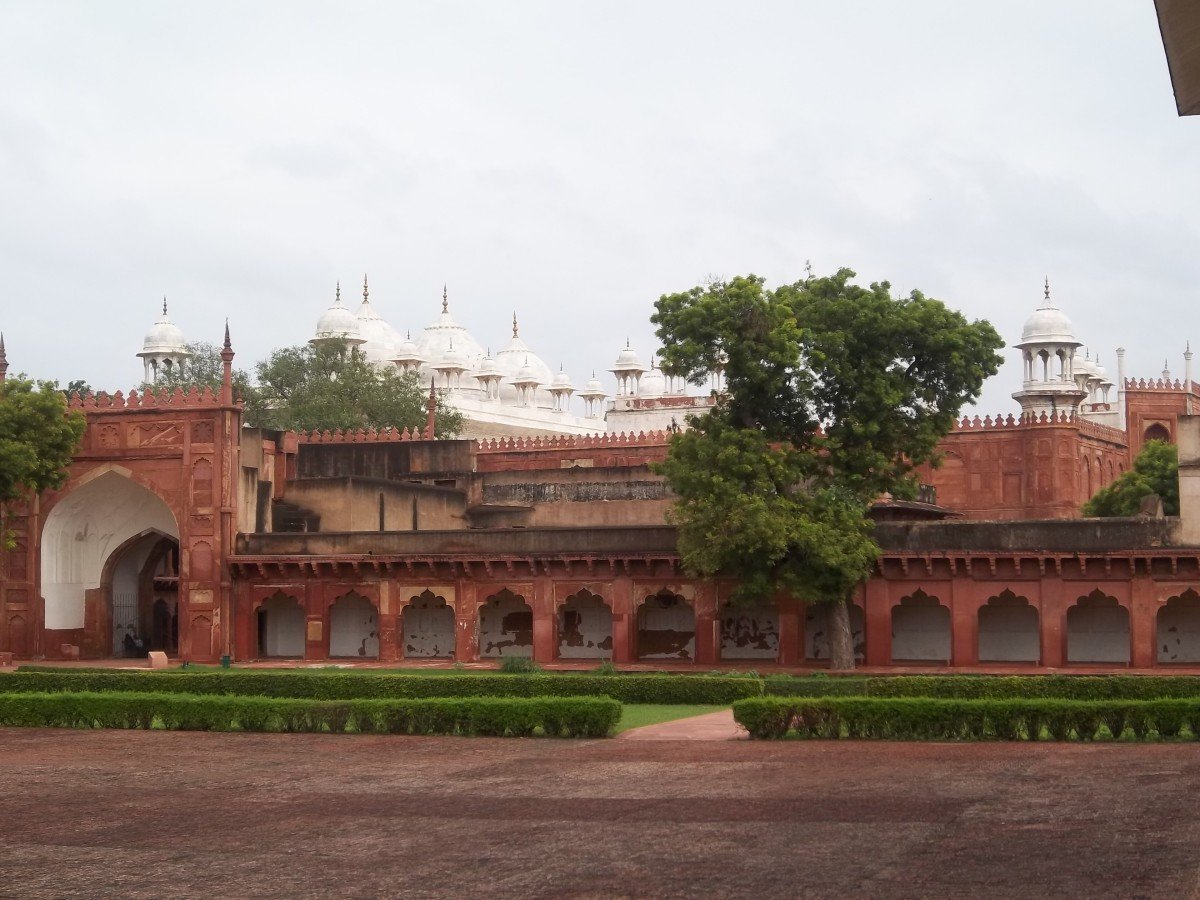
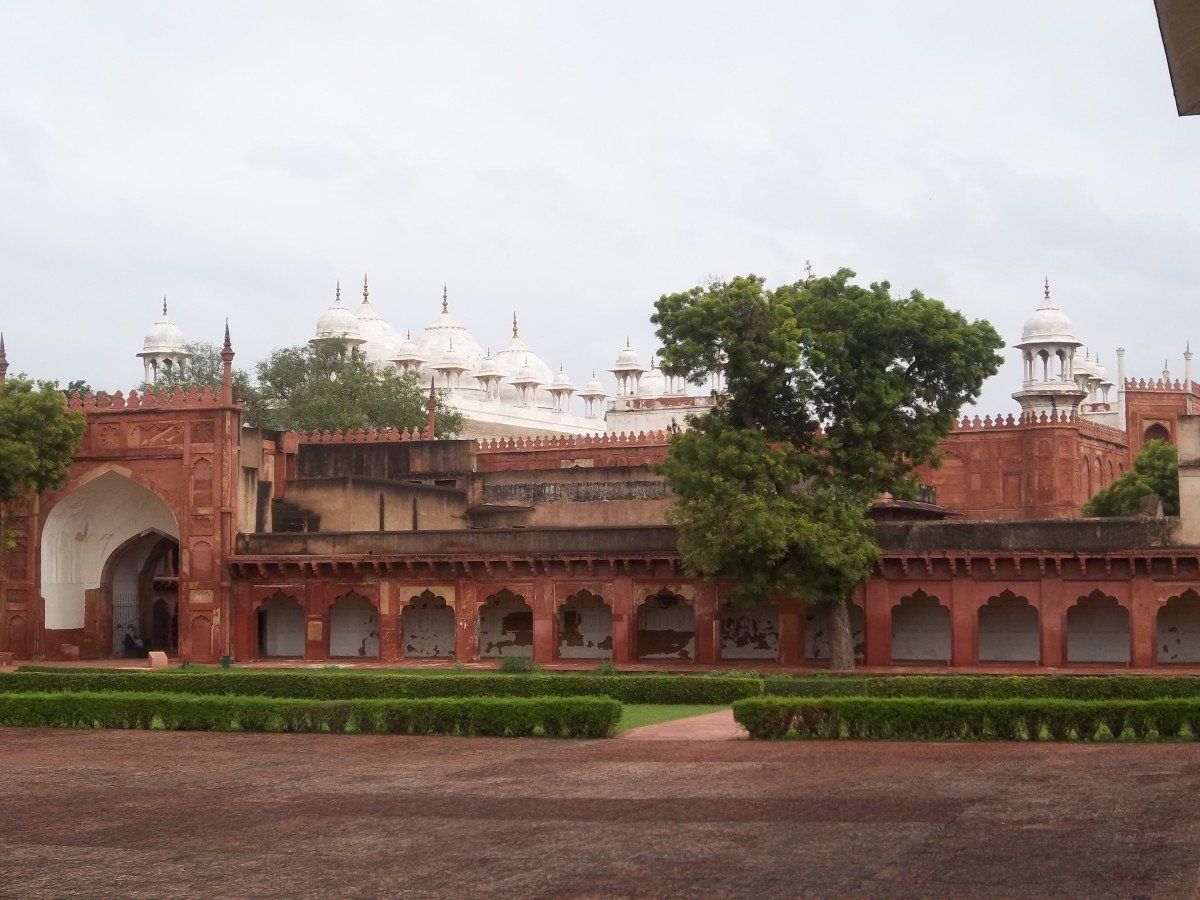
The Courtyard Panorama: The vast white marble courtyard is the prime photo spot. Stand near the eastern entrance archway and take a wide shot that captures the entire prayer hall, the three majestic domes, and the central ablution tank, emphasizing the overwhelming purity o...The Courtyard Panorama: The vast white marble courtyard is the prime photo spot. Stand near the eastern entrance archway and take a wide shot that captures the entire prayer hall, the three majestic domes, and the central ablution tank, emphasizing the overwhelming purity of the white marble against the red sandstone walls of the fort.
The Ablution Tank Reflection: On a day with still water, the central ablution tank can provide a magnificent reflection of the three domes and the prayer hall facade. This is an excellent spot for symmetrical and artistic reflection photography, highlighting the Pearl Mosque's beauty.
Framing with the Red Sandstone: Use the beautiful, arched red sandstone entrance gates (especially the eastern one) to frame the white marble prayer hall. The strong color contrast between the red sandstone of the gate and the white marble of the mosque creates a visually dynamic and impactful composition, perfectly showcasing the Mughal building transition.
The Marble Prayer Mat Inlays: A close-up or low-angle shot of the inlaid black marble lines on the prayer hall floor, showing the perfectly aligned musallas (prayer rugs), is a great photo opportunity that focuses on the fine details of Shah Jahan's craftsmanship.Photo Gallery
Things To Do
-
Exploring the Fort Complex: As the Moti Masjid is located inside the Agra Fort, a major thing to do is to explore the entire UNESCO World Heritage Site. Visitors spend hours exploring other magnificent structures like the Diwan-i-Aam (Hall of Public Audience), the Diwan-i-Khas (Hall of Private Audience), the Musamman Burj, and the Sheesh Mahal (Mirror Palace). The ticket to the fort covers the mosque, so one must dedicate a full half-day to the entire complex.
Appreciating the Marble Craftsmanship: Spend time closely examining the details of the white marble. Look at the inlaid designs, the intricate jali (screen) work of the Zenana section, and the subtle relief carving on the walls and pillars. The perfection and luminosity of the marble are best appreciated up close.
Quiet Contemplation: D...Exploring the Fort Complex: As the Moti Masjid is located inside the Agra Fort, a major thing to do is to explore the entire UNESCO World Heritage Site. Visitors spend hours exploring other magnificent structures like the Diwan-i-Aam (Hall of Public Audience), the Diwan-i-Khas (Hall of Private Audience), the Musamman Burj, and the Sheesh Mahal (Mirror Palace). The ticket to the fort covers the mosque, so one must dedicate a full half-day to the entire complex.
Appreciating the Marble Craftsmanship: Spend time closely examining the details of the white marble. Look at the inlaid designs, the intricate jali (screen) work of the Zenana section, and the subtle relief carving on the walls and pillars. The perfection and luminosity of the marble are best appreciated up close.
Quiet Contemplation: Due to its serene atmosphere, a key activity is to sit quietly in the courtyard and contemplate the history and the sheer beauty of the space. The mosque offers a peaceful retreat from the bustling and historically dramatic areas of the fort.
Photography of the Symmetrical Domes: Capture the stunning symmetry of the three white marble domes against the blue sky. The courtyard offers wide-angle shots that emphasize the pearl-like purity of the structure. Take photographs of the contrasting red sandstone archways and the white marble prayer hall.
Observing the Prayer Hall Floor: Walk through the prayer hall and observe the faint, black marble inlay lines on the floor, which clearly demarcate the spaces for the 670 individual worshippers. This detail gives a tangible sense of the scale and organization of royal prayer ceremonies during the Mughal era.
Tracing the Water System: Look for the subtle remains of the ancient water channels and tanks used for ablutions and maintaining the humidity, which were sophisticated engineering marvels for the 17th century.
Guided Fort Tours: Hire an official guide at the Agra Fort to get in-depth historical narratives about the mosque, its use by the royal family, and its connection to the rest of the fort's architecture and history, which can greatly enrich the visit.
Information
-
Why Famous:
Shah Jahan's White Marble Legacy: The mosque is famous as the crowning achievement of white marble religious architecture within the Agra Fort. It was built at the peak of Emperor Shah Jahan's artistic patronage, just before or around the completion of the Taj Mahal. It sh...Shah Jahan's White Marble Legacy: The mosque is famous as the crowning achievement of white marble religious architecture within the Agra Fort. It was built at the peak of Emperor Shah Jahan's artistic patronage, just before or around the completion of the Taj Mahal. It showcases his preference for the purity and softness of white marble over his predecessors' use of red sandstone, thus marking a significant evolution in Mughal architecture. The sheer luminosity and pristine state of the marble, which truly resembles a pearl, is the primary reason for its global recognition.
Royal Exclusivity and Purpose: Unlike the Jama Masjid, the Moti Masjid was exclusively reserved for the women of the royal household (Zenana) and the dignitaries of the court. This royal exclusivity imbues the mosque with a unique historical significance, marking it as a private sanctuary of the Mughal elite. Its status as an imperial place of worship, built for devotion by the highest echelons of society, distinguishes it from other larger, public mosques. Its fame also lies in the fact that it perfectly embodies the transition from the robust architecture of Akbar to the refined elegance of Shah Jahan. -
Architecture:
Purity in White Marble: The Moti Masjid is almost entirely constructed of pure white marble, making it a masterpiece of refined elegance and simplicity in contrast to the red sandstone of the surrounding Agra Fort. This use of white marble is the mosque's most distinguishin...Purity in White Marble: The Moti Masjid is almost entirely constructed of pure white marble, making it a masterpiece of refined elegance and simplicity in contrast to the red sandstone of the surrounding Agra Fort. This use of white marble is the mosque's most distinguishing architectural feature. The mosque follows a classic three-domed design, with the central dome slightly larger and taller than the flanking two, all of which are built in the signature low-profile Shah Jahan style. The dimensions of the main courtyard are approximately 158 feet by 154 feet, while the prayer hall is about 142 feet by 56 feet. The complex is entered through three magnificent gateways: one main eastern gate, and two subsidiary side gates (northern and southern), built of red sandstone with marble inlay, providing a color contrast.
Symmetrical and Serene Layout: The main courtyard is a vast, open, and perfectly square area, paved with white marble slabs that create a stunning visual pattern, and features a central ablution tank (hauz) used for ritual washing before prayer. The prayer hall (Liwan) is a majestic arcade of twelve-sided pillars and seven bays, divided by exquisitely carved arches. The floor of the prayer hall is inlaid with faint markings, resembling the outline of individual prayer rugs (musallas), with 670 such demarcations for the congregation, showcasing the extreme detail in the planning. The main sanctuary is flanked by side cloisters supported by beautiful, slender columns. The entire mosque stands on a raised plinth or platform, giving it a commanding view of the fort complex and highlighting its architectural superiority. -
How To Reach:
By Air: The nearest domestic airport is Kheria Airport (AGR), approximately 8 KM away. From AGR, one can hire a pre-paid taxi, a ride-sharing cab, or an auto-rickshaw directly to the Agra Fort's main gate, a journey of about 20 minutes. The closest international airport is...By Air: The nearest domestic airport is Kheria Airport (AGR), approximately 8 KM away. From AGR, one can hire a pre-paid taxi, a ride-sharing cab, or an auto-rickshaw directly to the Agra Fort's main gate, a journey of about 20 minutes. The closest international airport is Indira Gandhi International Airport (DEL) in New Delhi (230 KM). Travelers from DEL can use the Yamuna Expressway via a private taxi or cab, a 3-4 hour comfortable drive.
By Train: The Agra Fort Railway Station (AF) is the closest station, located just under 1 KM from the mosque's entrance. Agra Cantt (AGC) is the main, larger station, located about 6 KM away. From either station, you can easily take an auto-rickshaw, cycle-rickshaw, or e-rickshaw right up to the fort's main gate, from where a short walk leads to the ticket counter.
By Road: Agra is a major city and is well-connected by road networks like the Yamuna Expressway (connecting to Delhi) and NH-44 (connecting to Gwalior and Jabalpur). Private cars, rented taxis, and state-run bus services from major northern Indian cities terminate at the Idgah Bus Stand, which is about 4 KM away from the fort.
By Local Transport: The most convenient local transport to the Agra Fort is an auto-rickshaw or an e-rickshaw. Due to the high-security zone, private vehicles are often not allowed to park directly near the main entrance, so it is often better to use a cycle-rickshaw for the final few hundred meters from the nearest designated drop-off point, which adds to the historical travel experience. -
Weather and Best Time to Visit:
Winter Season (October to March): This is the optimal season for visiting Moti Masjid and the Agra Fort complex. The weather is cool and pleasant throughout the day, making the exploration of the large fort grounds comfortable. The light on the white marble is clear and br...Winter Season (October to March): This is the optimal season for visiting Moti Masjid and the Agra Fort complex. The weather is cool and pleasant throughout the day, making the exploration of the large fort grounds comfortable. The light on the white marble is clear and bright without the intensity of the summer sun.
Monsoon Season (July to September): The occasional rainfall can make the marble floors slightly slippery, but the sky is often overcast, providing a beautiful, soft, and uniform light that minimizes glare, making it excellent for photography. The air is also noticeably cooler after a shower.
Summer Season (April to June): This period is generally challenging due to the extreme heat. The midday sun can make the white marble floors unbearably hot, and the air is dry and dusty. If visiting in summer, strictly aim for the early opening hours (6:00 AM) to ensure a comfortable experience before the heat peaks.
Different Parts of the Day: Sunrise (Opening Time) is highly recommended for the best light, lowest crowds, and coolest temperatures. Visiting during the late afternoon is also viable, but the crowds inside the main fort complex tend to be higher. -
Near Tourist Places:
Agra Fort (Inside Complex, 0 KM) Jama Masjid (1 KM) Taj Mahal (3 KM) Itimad-ud-Daulah's Tomb (4 KM) Mehtab Bagh (6 KM) Ram Bagh (6 KM) Tomb of Akbar the Great (Sikandra) (10 KM) Tomb of Mariam-uz-Zamani (12 KM) Fatehpur Sikri (40 KM) Sadar Bazaar (4 KM)
Tourism Tips
-
Health & Safety: The mosque requires visitors to remove their shoes; wear or carry thick socks, especially if visiting after the early morning, as the white marble floor can become extremely hot due to sun reflection. Stay well-hydrated while exploring the large fort compl...Health & Safety: The mosque requires visitors to remove their shoes; wear or carry thick socks, especially if visiting after the early morning, as the white marble floor can become extremely hot due to sun reflection. Stay well-hydrated while exploring the large fort complex. Security is high since it is inside a major fort, but always be aware of your surroundings.
Packing: Essential items include a Camera for capturing the marble's purity, Sunglasses to counter the intense glare, and perhaps a small towel or scarf for sun protection. A small bag is best for ease of movement within the large fort.
Accommodation: Accommodation should be booked near the Agra Fort or Taj Mahal East Gate area for easy access. There are many budget and mid-range hotels surrounding the fort that offer close proximity to the city's main attractions.
Other Tourism Tips: The Moti Masjid is often overlooked by tourists rushing through the fort, so allocate specific time to find it and appreciate its tranquility. Hire an official, licensed fort guide at the entrance for detailed historical context about the mosque and the fort's other structures. Dress modestly, as it is a religious structure.
Reviews
FAQs
Agra Itineray And Cost:-
Other Places In Agra :-
Other States In India :-
Information about New and Updated Locations() of Uttar Pradesh Has Been Added :-
Card subtitle
Note:-
Information provided here in good Faith and for reference only.
Near Places
Agra Fort
Some quick example text to build on the card title and make up the bulk of the card's content.
Go somewhere
Akbar's Tomb
Some quick example text to build on the card title and make up the bulk of the card's content.
Go somewhere
Chini Ka Rauza
Some quick example text to build on the card title and make up the bulk of the card's content.
Go somewhere
Gurudwara Guru Ka Taal
Some quick example text to build on the card title and make up the bulk of the card's content.
Go somewhere
Itmad-ud-Daulah's Tomb
Some quick example text to build on the card title and make up the bulk of the card's content.
Go somewhere
Jahangiri Mahal
Some quick example text to build on the card title and make up the bulk of the card's content.
Go somewhere
Jama Masjid
Some quick example text to build on the card title and make up the bulk of the card's content.
Go somewhere
Khas Mahal
Some quick example text to build on the card title and make up the bulk of the card's content.
Go somewhere
Kinari Bazaar
Some quick example text to build on the card title and make up the bulk of the card's content.
Go somewhere
Mankameshwar Temple
Some quick example text to build on the card title and make up the bulk of the card's content.
Go somewhere
Mariam's Tomb
Some quick example text to build on the card title and make up the bulk of the card's content.
Go somewhere
Mehtab Bagh
Some quick example text to build on the card title and make up the bulk of the card's content.
Go somewhere
Moti Masjid
Some quick example text to build on the card title and make up the bulk of the card's content.
Go somewhere
Ram Bagh
Some quick example text to build on the card title and make up the bulk of the card's content.
Go somewhere
Soor Sarovar Bird Sanctuary
Some quick example text to build on the card title and make up the bulk of the card's content.
Go somewhere
Taj Mahal
Some quick example text to build on the card title and make up the bulk of the card's content.
Go somewherein Other Cities