
Tansen's Tomb
General information
-
Ideal Duration:
1 HourPlace Type:
Historical Site, Cultural Monument, Tomb/MemorialEntry Fees:
General Admission: FREE. There is absolutely no entry fee to visit the complex containing both Tansen's Tomb and the tomb of Muhammad Ghaus. The site is a national monument maintained by the Archaeological Survey of India (ASI), ensuring public access.
Read MoreGeneral Admission: FREE. There is absolutely no entry fee to visit the complex containing both Tansen's Tomb and the tomb of Muhammad Ghaus. The site is a national monument maintained by the Archaeological Survey of India (ASI), ensuring public access.
Fees for Tansen Samaroh: While the site is generally free, during the annual Tansen Samaroh in December, there may be ticketed seating or special entry zones for the performance area, though general access to the grounds often remains open. It is advisable to check the festival's official schedule for any applicable charges.
Camera and Parking Fees: There are typically no fees for still cameras or video cameras for personal use. A nominal fee for vehicle parking might be charged in the designated parking lot outside the complex, which is a common practice at most major tourist spots in India.
Donations: Visitors are welcome to leave a voluntary donation to the caretakers or in designated donation boxes, but this is entirely at the visitor's discretion and is not mandatory for entry.Timing:
Regular Timings: The site is generally open from 8:00 AM to 6:00 PM on all days of the week. Being an open-air monument complex, these hours align with typical daylight access.
Ideal Visit Time: Early Morning (8:00 AM - 10:00 AM) or Late Af...Regular Timings: The site is generally open from 8:00 AM to 6:00 PM on all days of the week. Being an open-air monument complex, these hours align with typical daylight access.
Ideal Visit Time: Early Morning (8:00 AM - 10:00 AM) or Late Afternoon (4:00 PM - 6:00 PM). The early morning offers the best light for photography, the coolest weather, and maximum tranquility for contemplation. Late afternoon is pleasant, and the complex is often quieter than the mid-day hours.
Festival Timings: During the Tansen Samaroh in December, the complex remains open much later, often until late at night, as the music performances typically start in the evening and continue well into the night. This is a very special, temporary timing for the event.Special Events:
Tansen Samaroh (Annual Music Festival): This is the pre-eminent special event, held annually in the month of December (usually the week of Tansen's death anniversary). The four-day festival is one of India's most prestigious classical music events, attracting top-tier Hindu...Tansen Samaroh (Annual Music Festival): This is the pre-eminent special event, held annually in the month of December (usually the week of Tansen's death anniversary). The four-day festival is one of India's most prestigious classical music events, attracting top-tier Hindustani classical musicians (both vocalists and instrumentalists) from all over the country. The performances take place in the open-air courtyard right next to the tombs, creating an unparalleled atmosphere of musical reverence.
National Cultural Significance: The festival is sponsored and organized by the Madhya Pradesh government's culture department and is a national event, drawing thousands of music enthusiasts. Attending provides a deep immersion into the living tradition of Hindustani Classical Music, directly connected to Tansen's legacy.
Informal Mehfils and Homage: Throughout the year, especially on auspicious musical days, local music schools or traveling artists may hold small, impromptu musical gatherings (Mehfils) near the tomb as a gesture of homage to the Sangeet Samrat. These provide a more intimate, unscripted cultural experience.Best Photo Spots:
The Archway Framing the Tomb: The most iconic and best photograph can be taken by framing Tansen’s tomb through one of the beautiful carved stone archways of the larger Muhammad Ghaus Tomb enclosure. This uses the impressive Mughal architecture as a natural frame for the ...The Archway Framing the Tomb: The most iconic and best photograph can be taken by framing Tansen’s tomb through one of the beautiful carved stone archways of the larger Muhammad Ghaus Tomb enclosure. This uses the impressive Mughal architecture as a natural frame for the simpler, more significant memorial.
Up Close with the Neem Tree: A photograph capturing a visitor touching or simply standing beside the legendary Neem tree next to the grave is a powerful shot that embodies the mystical-musical connection of the site. It is a unique 'natural' monument to capture.
The Jali Work and Shadow Play: On a bright, sunny day, capture the intricate patterns created by the sunlight filtering through the delicate Jali (lattice screen) windows of the surrounding structures. These geometric light-and-shadow compositions make for abstract and highly aesthetic cultural photos.
Wide Shot of the Complex: From a higher vantage point within the complex (like the rooftop of the Muhammad Ghaus tomb, if accessible), capture a wide-angle shot of the entire complex: the large tomb, the smaller tomb, and the sprawling, quiet garden, to show the scale and serene atmosphere of the historical site.Photo Gallery
Things To Do
-
Quiet Contemplation at the Gravesite: Spend a moment of silence at Tansen's gravesite. The simplicity of the open structure is meant to invite reflection on the musician's immense life and work. Try to visualize the music that once flowed from this great master. This is the core devotional activity for any music lover.
Explore the Tomb of Muhammad Ghaus: Dedicate a significant portion of your time to exploring the magnificent and larger tomb of Tansen's spiritual mentor. Admire its imposing central dome, the unique architectural blend, and the remnants of its beautiful blue-tile decorations, which are a major architectural landmark themselves.
The Neem Tree Ritual: Partake in the popular local tradition of locating and observing the famous Neem tree. While you don't have to chew a leaf, witn...Quiet Contemplation at the Gravesite: Spend a moment of silence at Tansen's gravesite. The simplicity of the open structure is meant to invite reflection on the musician's immense life and work. Try to visualize the music that once flowed from this great master. This is the core devotional activity for any music lover.
Explore the Tomb of Muhammad Ghaus: Dedicate a significant portion of your time to exploring the magnificent and larger tomb of Tansen's spiritual mentor. Admire its imposing central dome, the unique architectural blend, and the remnants of its beautiful blue-tile decorations, which are a major architectural landmark themselves.
The Neem Tree Ritual: Partake in the popular local tradition of locating and observing the famous Neem tree. While you don't have to chew a leaf, witnessing the deep respect and belief surrounding this tree by local musicians is a unique cultural activity that connects directly to Tansen's legend.
Observe the Mughal Architectural Details: Take time to study the intricate Jali screens and the carvings on the columns and plinths of the entire complex. These architectural elements are excellent examples of the fusion of Persian, Turkic, and indigenous Indian styles, characterized by the delicate patterns and use of red sandstone.
Relax in the Charbagh Gardens: The tombs are set within a large, traditional Charbagh (four-part Mughal garden) style courtyard. Take a leisurely stroll or sit on one of the benches to enjoy the tranquility. The greenery provides a calming contrast to the historical monuments.
Attend a Local Music Session (Informal): Occasionally, local music students or traveling musicians visit the tomb to practice or perform a piece in homage. Keep an ear out for such informal, spontaneous performances—they are a deeply moving and authentic way to experience the legacy of Tansen alive today.
Visit the Hazira Neighbourhood: The surrounding Hazira area is one of the oldest parts of Gwalior. Walk through the nearby lanes to soak in the atmosphere, perhaps sampling local food or visiting small, historic mosques and temples, which completes the picture of the historical context of the 16th-century city.
Plan for the Tansen Samaroh: If you are visiting in December, plan your trip to coincide with the Tansen Samaroh (Music Festival). Attending this event is the ultimate thing to do here, offering world-class classical music performances at the master’s resting place.
Information
-
Why Famous:
Legacy of Hindustani Classical Music: Tansen is perhaps the most famous figure in the entire history of Hindustani classical music. His contributions, including the creation of several important Ragas (melodic modes), like Miyan Ki Todi and Darbari Kanada, make his tomb a p...Legacy of Hindustani Classical Music: Tansen is perhaps the most famous figure in the entire history of Hindustani classical music. His contributions, including the creation of several important Ragas (melodic modes), like Miyan Ki Todi and Darbari Kanada, make his tomb a pilgrimage site for all musicians and musicologists globally.
The Guru-Shishya Bond: It is famously known for its close proximity to the tomb of his Sufi saint guru, Muhammad Ghaus. This dual-tomb complex is a powerful symbol of the profound spiritual and professional bond between master and disciple, a cornerstone of Indian learning and culture. Tansen’s request to be buried next to his guru solidified the importance of this relationship.
Host of Tansen Samaroh: The tomb is the annual venue for the prestigious Tansen Samaroh, a four-day national-level music festival held every December. The open-air performances held here, right next to his resting place, make the site instantly famous as a sacred stage for classical music.
Historical Context and Mughal Court: As one of the Navratnas (Nine Jewels) of Emperor Akbar's court, the tomb is a direct link to the glorious cultural zenith of the Mughal Empire and the age of immense artistic patronage. The entire complex in Hazira is steeped in this rich, historical-cultural milieu. -
Architecture:
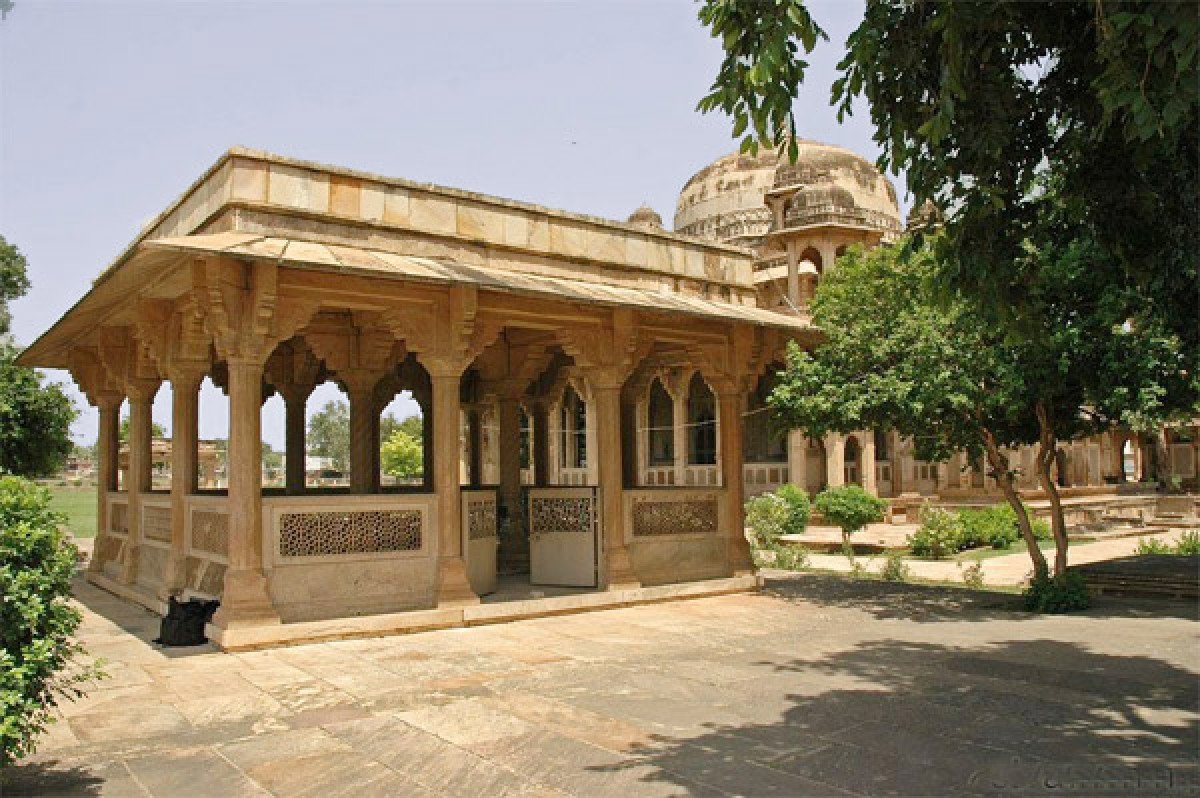
Mughal-era Architecture and Simplicity: The tomb is an example of relatively simple Mughal architecture, contrasting with the grander tomb of Muhammad Ghaus nearby. It is an open pavilion structure supported by slender stone pillars, without the massive dome or ornate tilew...Mughal-era Architecture and Simplicity: The tomb is an example of relatively simple Mughal architecture, contrasting with the grander tomb of Muhammad Ghaus nearby. It is an open pavilion structure supported by slender stone pillars, without the massive dome or ornate tilework of the main tomb. It features delicate lattice-work screens (Jali) in stone, allowing light to filter in, symbolizing spiritual lightness.
Material and Craftsmanship: The structure is primarily constructed of locally sourced red and beige sandstone. The craftsmanship is evident in the finely carved pillars and the subtle, geometric patterns of the Jali screens, reflecting the Indo-Islamic design principles prevalent during the 16th-century Mughal period.
Setting and Scale: The tomb is modest in scale, intentionally overshadowed by the tomb of his guru, Muhammad Ghaus, underscoring the importance of the master-disciple (Guru-Shishya) tradition. It sits on a simple plinth within a spacious, charbagh-style garden complex. The simplicity emphasizes the focus on the musical legacy rather than architectural grandeur.
The Neem Tree: Directly next to the tomb is a large, sacred Neem tree. While not part of the original architecture, it has become an integral and famous part of the site. Local legend says that chewing a leaf from this tree can bestow a sweet voice or musical talent. This tree is a living 'dimension' of the site's fame. -
How To Reach:
By Air: The nearest airport is Gwalior Airport (GWL), approximately 10-12 KMS away. From the airport, hire a pre-paid taxi or a ride-sharing service. The journey takes about 25-30 minutes, depending on traffic.
By Train: The nearest major ...By Air: The nearest airport is Gwalior Airport (GWL), approximately 10-12 KMS away. From the airport, hire a pre-paid taxi or a ride-sharing service. The journey takes about 25-30 minutes, depending on traffic.
By Train: The nearest major railway station is Gwalior Junction (GWL), which is extremely well-connected across India. The complex is approximately 7 KMS from the station. The area, Hazira, is a very well-known locality. You can hire an auto-rickshaw or taxi, which is the most convenient way. Always agree on the fare beforehand.
By Road: Gwalior is well-connected by National Highways. The tomb is located in the old part of the city in the Hazira area and is easily navigable using a GPS device. City buses or state-run transport may reach nearby stands, requiring a short walk or a cycle-rickshaw ride.
By Local Transport: Auto-rickshaws and cycle-rickshaws are abundant. Given the location in a traditional neighborhood, a cycle-rickshaw can be a charming way to navigate the final local lanes. The location is easily found by simply mentioning "Tansen ka Maqbara" or "Ghaus Mohammad ka Maqbara" to any local driver. -
Weather and Best Time to Visit:
Types of Seasons: Winter (October to March) is the Best Time to Visit. The weather is cool, dry, and highly conducive for both sightseeing and attending the annual music festival in December. Summer is very hot and should be avoided. Monsoon can make the gardens lush but ...Types of Seasons: Winter (October to March) is the Best Time to Visit. The weather is cool, dry, and highly conducive for both sightseeing and attending the annual music festival in December. Summer is very hot and should be avoided. Monsoon can make the gardens lush but also humid.
Different Parts of the Day: Late Afternoon is arguably the most ideal time, especially as the sun begins to set and casts a golden glow on the sandstone architecture. This time is also perfect if you plan to stay until evening for any informal musical homage or simply to feel the quiet reverence of the site as the day ends. Mid-day heat can make walking in the open courtyard challenging. -
Near Tourist Places:
Muhammad Ghaus Tomb (Inside Complex), Gwalior Fort (7 KMS), Gwalior Zoo (6 KMS), Jai Vilas Palace (7. 5 KMS), Samadhi of Rani Laxmi Bai (7 KMS), Sun Temple (7 KMS), Gopachal Parvat Jain Sculptures (7. 5 KMS), Sas-Bahu Temple (Inside Fort), Man Mandir Palace (Inside Fort), Teli Ka Mandir (Inside Fort).
Tourism Tips
-
Health & Safety: The site is generally safe and maintained by the ASI. Watch your step on uneven paving stones in the older sections of the complex. The Neem tree is sacred, so treat it with respect. Carry water, especially on hot days, as the courtyards are open-air.Health & Safety: The site is generally safe and maintained by the ASI. Watch your step on uneven paving stones in the older sections of the complex. The Neem tree is sacred, so treat it with respect. Carry water, especially on hot days, as the courtyards are open-air.
Packing Essentials: A good camera is essential, especially for capturing the architectural details and the lovely garden setting. If visiting in December for the festival, pack warm clothing as the nights can be quite cold. Dress modestly out of respect for the religious/cultural nature of the site, particularly when visiting the tomb of the Sufi saint Muhammad Ghaus.
Accommodation: Stay in the Lashkar or Gwalior Fort area for easy access to other sites. The Hazira area itself is more residential. Book accommodations well in advance if you plan to visit during the peak season or the Tansen Samaroh in December.
Local Experience: The Hazira locality is famous for local eateries. Try the traditional sweet dishes or street food in the vicinity for a true taste of old Gwalior. Don't hesitate to engage with local musicians or students you may meet here.
Reviews
FAQs
Gwalior Itineray And Cost:-
Other Places In Gwalior :-
Other States In India :-
Information about New and Updated Locations() of Madhya Pradesh Has Been Added :-
Card subtitle
Note:-
Information provided here in good Faith and for reference only.
Near Places

Assi Khamba Ki Bawadi
Some quick example text to build on the card title and make up the bulk of the card's content.
Go somewhere
Bhadawana Waterfall
Some quick example text to build on the card title and make up the bulk of the card's content.
Go somewhere
Captain Roop Singh Stadium
Some quick example text to build on the card title and make up the bulk of the card's content.
Go somewhere
Durbar Hall
Some quick example text to build on the card title and make up the bulk of the card's content.
Go somewhere
Gopachal Parvat
Some quick example text to build on the card title and make up the bulk of the card's content.
Go somewhere
Gopachal Parvat Jain Sculptures
Some quick example text to build on the card title and make up the bulk of the card's content.
Go somewhere
Gujari Mahal Archaeological Museum
Some quick example text to build on the card title and make up the bulk of the card's content.
Go somewhere
Gurudwara Data Bandi Chhod
Some quick example text to build on the card title and make up the bulk of the card's content.
Go somewhere
Gwalior Fort
Some quick example text to build on the card title and make up the bulk of the card's content.
Go somewhere
Gwalior Safari
Some quick example text to build on the card title and make up the bulk of the card's content.
Go somewhere
Gwalior Trade Fair Ground
Some quick example text to build on the card title and make up the bulk of the card's content.
Go somewhere
Hazira Chowk
Some quick example text to build on the card title and make up the bulk of the card's content.
Go somewhere
Jai Vilas Palace & Museum
Some quick example text to build on the card title and make up the bulk of the card's content.
Go somewhere
Jiyaji Chowk Bazaar
Some quick example text to build on the card title and make up the bulk of the card's content.
Go somewhere
Ladhedi Gate
Some quick example text to build on the card title and make up the bulk of the card's content.
Go somewhere
Lashkar City Area
Some quick example text to build on the card title and make up the bulk of the card's content.
Go somewherein Other Cities