
-India-(Country)-622-1200x1200.jpg?text=Slide+2)
-India-(Country)-235-1200x1200.jpg?text=Slide+3)

-India-(Country)-451-1200x1200.jpg?text=Slide+6)


-India-(Country)-622-1200x1200.jpg)
Fatehpur Sikri
General information
-
Ideal Duration:
1 DayPlace Type:
Heritage & HistoryEntry Fees:
Indian Visitors: The entry fee for Indian nationals is 50 rupees, while children below 15 years can enter the historical complex for free.
Foreign Tourists: International visitors are charged 610 rupees, which includes the ASI entry fee and ...Indian Visitors: The entry fee for Indian nationals is 50 rupees, while children below 15 years can enter the historical complex for free.
Foreign Tourists: International visitors are charged 610 rupees, which includes the ASI entry fee and the local toll tax for the monument.Timing:
Regular Timings: The monument complex is open from sunrise to sunset every day, with the Dargah area remaining accessible slightly later for evening prayers.
Ideal Time: Arriving at the gates at 6:00 AM allows you to explore in peace before ...Regular Timings: The monument complex is open from sunrise to sunset every day, with the Dargah area remaining accessible slightly later for evening prayers.
Ideal Time: Arriving at the gates at 6:00 AM allows you to explore in peace before the large crowds arrive from Agra around mid-morning.Special Events:
Urs of Salim Chishti: An annual religious gathering where thousands of devotees offer 'Chadar' and participate in soul-stirring qawwali sessions at the Dargah.
Agra Mahotsav: Often celebrated in conjunction with nearby Agra, featuring cultur...Urs of Salim Chishti: An annual religious gathering where thousands of devotees offer 'Chadar' and participate in soul-stirring qawwali sessions at the Dargah.
Agra Mahotsav: Often celebrated in conjunction with nearby Agra, featuring cultural performances that highlight the Mughal heritage of the entire region.Best Photo Spots:
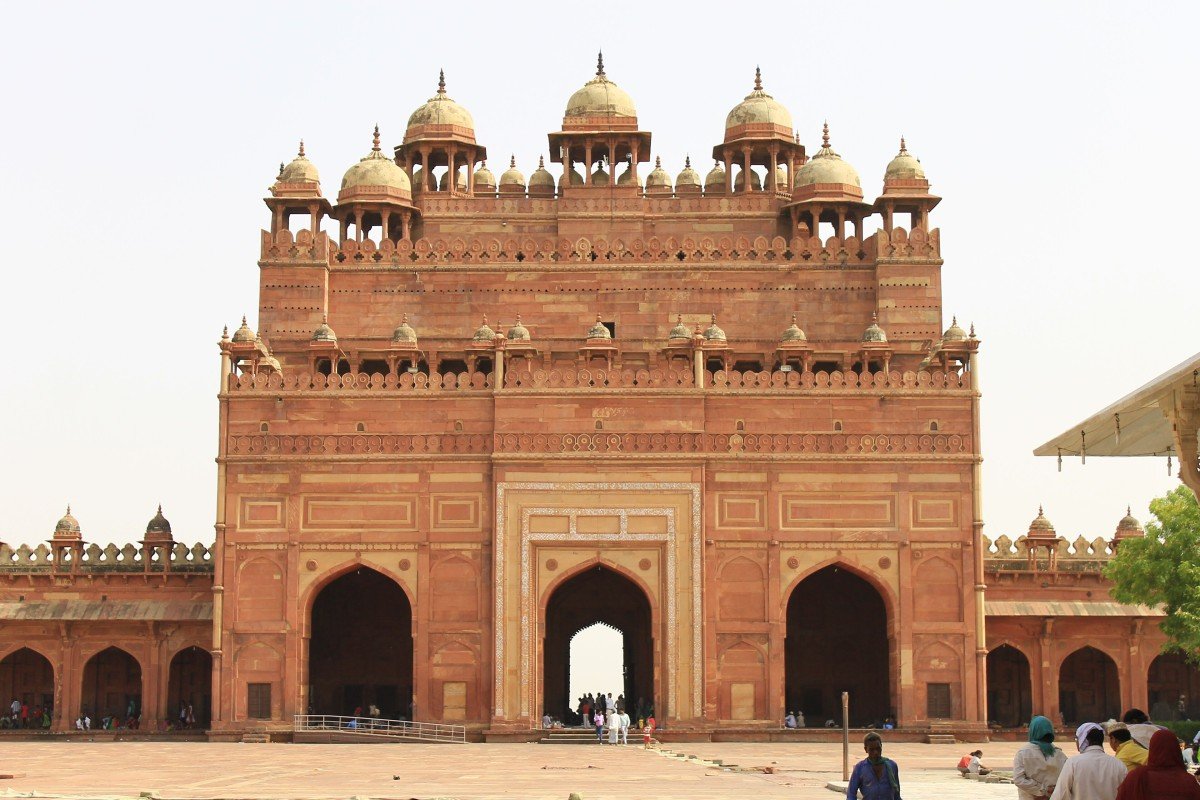
Buland Darwaza Base: Taking a photo from the bottom of the steps looking up captures the true, overwhelming scale of this massive world-famous gateway.
Jodha Bai Palace: The ornate courtyards and carved pillars of the queen's palace offer a ...Buland Darwaza Base: Taking a photo from the bottom of the steps looking up captures the true, overwhelming scale of this massive world-famous gateway.
Jodha Bai Palace: The ornate courtyards and carved pillars of the queen's palace offer a symmetrical and regal setting for high-quality heritage photography.Photo Gallery
-India-(Country)-235-1200x1200.jpg)

-India-(Country)-451-1200x1200.jpg)


Things To Do
 @@History and Purpose: Also known as the Sangtarashon ki Masjid, it is arguably the oldest mosque on the Fatehpur Sikri ridge, predating Akbar's imperial city by several years. It was built around 1564 AD by the local stonecutters (Sangtarash) community who were working in the Sikri quarries. It is historically significant as it is believed to be where Sheikh Salim Chishti used to offer his prayers before the much larger Jama Masjid was constructed. The small, simple structure reflects a period of early settlement and religious devotion on the ridge. @@The Sheikh's Residence: The mosque is located near the cave where Sheikh Salim Chishti lived and mediated, tying it directly to the spiritual origin story of Fatehpur Sikri becoming Akbar's capital. The community built it for the venerated Sufi saint.
 @@Role in Mughal Trade and Administration: The Caravanserai was a crucial piece of civic and commercial infrastructure for Fatehpur Sikri, designed as a luxurious guest house and inn for visiting dignitaries, important traders, and weary merchants traveling on the busy Agra-Jaipur route. Its existence underscores Akbar's commitment to fostering trade and securing his borders, as such inns were essential for the flow of goods and information across the empire. The structure is strategically positioned near the outer perimeter of the royal city, close to the Hathi Pol (Elephant Gate) and the public areas, distinguishing it from the private palaces. This placement made it easily accessible to travelers while maintaining the security and privacy of the inner imperial court. The complexity of the structure, featuring a grand courtyard surrounded by numerous rooms, suggests it catered to a high-status clientele. @@Architectural Layout and Amenities: Built from the ever-present red sandstone, the Caravanserai has a rectangular plan centered around a spacious quadrangular court. Rooms and chambers were built along all four sides of this courtyard, providing shelter and storage. While the pillared verandahs that once fronted these rooms have largely been demolished, the basic layout remains clear. The construction skillfully utilizes the natural slope of the ridge, leading to a terraced layout. Amenities for the guests were well-planned, evidenced by the remnants of a large tank and a well (likely the nearby Baoli) on the southeast side, ensuring a constant water supply for people and their animals. The main entrance, a gateway on the northwestern side, features an archway flanked by smaller arches, decorated with remnants of marble spandrels and simple stucco work, reflecting a pragmatic Mughal style that is less ornate than the palaces but still grand. @@A Center of Commerce and Rest: The Caravanserai was a bustling hub of activity—a place where cultures met, goods were exchanged, and political intelligence was often gathered. It was, in essence, the upscale business hotel and logistics center of the 16th-century capital. Today, the ruins offer a quiet, evocative space to imagine the clamor of merchants, the resting of camels and horses, and the vibrant commercial life that once animated the deserted city, providing a vivid contrast to the silent, artistic beauty of the inner palaces. Its architecture, though ruined, is a fine example of standardized Mughal public works.
@@Historical Context: These structures belonged to the brothers Abul Fazal (historian/chronicler) and Faizi (poet laureate), two of Emperor Akbar's "Nine Jewels" (Navratnas). They provide insight into the living standards of high-ranking Mughal courtiers in the 16th century. The buildings are simple yet elegant, reflecting a departure from the grand imperial palaces but maintaining a sense of noble stature. They are situated close to the religious and administrative center of the city.:
@@Unique Design and Purpose: The Panch Mahal (Five-Storeyed Palace) is one of the most distinctive and architecturally playful structures in Fatehpur Sikri, unique for its gradual tapering of five storeys and its entirely open-sided, pillared structure. It is often referred to as the Badgir or Wind Tower because its primary function was to serve as an airy, private recreational space for the royal ladies of the Haram Sara during the oppressive summer months. Its design, consisting of an escalating series of open columns, maximized air circulation and provided a shaded retreat from the courtyard heat. Its five storeys are a rare architectural feature in Mughal India, and the palace is deliberately situated next to the Anup Talao (the beautiful central water tank), using the evaporative cooling from the water to further lower the temperature within the structure. @@Architectural Influences and Progression: The design of the Panch Mahal is a magnificent example of Akbar's fusion architecture, often cited as drawing strong inspiration from the layout of traditional Buddhist Viharas (monasteries), which also employed multi-tiered, pillared structures for assembly and rest. It is a masterpiece of verticality and lightness. Each successive storey decreases in size, and the number of supporting columns progressively reduces: the ground floor rests on 84 pillars, the first on 56, the second on 20, the third on 12, and the top floor, a single small chhatri (domed kiosk), is supported by only 4 pillars. This unique structure was originally adorned with delicate stone lattice screens (jali) between the columns on every level, providing the necessary privacy (purdah) for the royal women who used the palace for viewing the court, music, and social events. @@Cultural and Symbolic Role: Standing as the tallest building in the inner palace, the Panch Mahal provides a visual landmark and a symbolic connection between the ground-level court and the sky. Its five-level construction, built entirely of red sandstone, offers a powerful sense of visual rhythm and vertical movement. The pillars on each floor are intricately carved, often featuring Hindu, Jain, and Persian motifs, reinforcing the palace's role as a symbol of Akbar's syncretic vision. The palace allowed the secluded royal ladies to secretly observe the activities in the nearby courtyards and the Diwan-i-Khas, making it a subtle but crucial element in the social and political dynamics of the court.
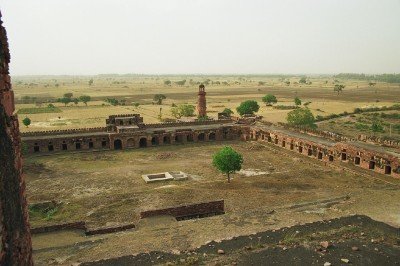
@@Role in Mughal Trade and Administration: The Caravanserai was a crucial piece of civic and commercial infrastructure for Fatehpur Sikri, designed as a luxurious guest house and inn for visiting dignitaries, important traders, and weary merchants traveling on the busy Agra-Jaipur route. Its existence underscores Akbar's commitment to fostering trade and securing his borders, as such inns were essential for the flow of goods and information across the empire. The structure is strategically positioned near the outer perimeter of the royal city, close to the Hathi Pol (Elephant Gate) and the public areas, distinguishing it from the private palaces. This placement made it easily accessible to travelers while maintaining the security and privacy of the inner imperial court. The complexity of the structure, featuring a grand courtyard surrounded by numerous rooms, suggests it catered to a high-status clientele. @@Architectural Layout and Amenities: Built from the ever-present red sandstone, the Caravanserai has a rectangular plan centered around a spacious quadrangular court. Rooms and chambers were built along all four sides of this courtyard, providing shelter and storage. While the pillared verandahs that once fronted these rooms have largely been demolished, the basic layout remains clear. The construction skillfully utilizes the natural slope of the ridge, leading to a terraced layout. Amenities for the guests were well-planned, evidenced by the remnants of a large tank and a well (likely the nearby Baoli) on the southeast side, ensuring a constant water supply for people and their animals. The main entrance, a gateway on the northwestern side, features an archway flanked by smaller arches, decorated with remnants of marble spandrels and simple stucco work, reflecting a pragmatic Mughal style that is less ornate than the palaces but still grand. @@A Center of Commerce and Rest: The Caravanserai was a bustling hub of activity—a place where cultures met, goods were exchanged, and political intelligence was often gathered. It was, in essence, the upscale business hotel and logistics center of the 16th-century capital. Today, the ruins offer a quiet, evocative space to imagine the clamor of merchants, the resting of camels and horses, and the vibrant commercial life that once animated the deserted city, providing a vivid contrast to the silent, artistic beauty of the inner palaces. Its architecture, though ruined, is a fine example of standardized Mughal public works.
@@Historical Context: These structures belonged to the brothers Abul Fazal (historian/chronicler) and Faizi (poet laureate), two of Emperor Akbar's "Nine Jewels" (Navratnas). They provide insight into the living standards of high-ranking Mughal courtiers in the 16th century. The buildings are simple yet elegant, reflecting a departure from the grand imperial palaces but maintaining a sense of noble stature. They are situated close to the religious and administrative center of the city.:
@@Unique Design and Purpose: The Panch Mahal (Five-Storeyed Palace) is one of the most distinctive and architecturally playful structures in Fatehpur Sikri, unique for its gradual tapering of five storeys and its entirely open-sided, pillared structure. It is often referred to as the Badgir or Wind Tower because its primary function was to serve as an airy, private recreational space for the royal ladies of the Haram Sara during the oppressive summer months. Its design, consisting of an escalating series of open columns, maximized air circulation and provided a shaded retreat from the courtyard heat. Its five storeys are a rare architectural feature in Mughal India, and the palace is deliberately situated next to the Anup Talao (the beautiful central water tank), using the evaporative cooling from the water to further lower the temperature within the structure. @@Architectural Influences and Progression: The design of the Panch Mahal is a magnificent example of Akbar's fusion architecture, often cited as drawing strong inspiration from the layout of traditional Buddhist Viharas (monasteries), which also employed multi-tiered, pillared structures for assembly and rest. It is a masterpiece of verticality and lightness. Each successive storey decreases in size, and the number of supporting columns progressively reduces: the ground floor rests on 84 pillars, the first on 56, the second on 20, the third on 12, and the top floor, a single small chhatri (domed kiosk), is supported by only 4 pillars. This unique structure was originally adorned with delicate stone lattice screens (jali) between the columns on every level, providing the necessary privacy (purdah) for the royal women who used the palace for viewing the court, music, and social events. @@Cultural and Symbolic Role: Standing as the tallest building in the inner palace, the Panch Mahal provides a visual landmark and a symbolic connection between the ground-level court and the sky. Its five-level construction, built entirely of red sandstone, offers a powerful sense of visual rhythm and vertical movement. The pillars on each floor are intricately carved, often featuring Hindu, Jain, and Persian motifs, reinforcing the palace's role as a symbol of Akbar's syncretic vision. The palace allowed the secluded royal ladies to secretly observe the activities in the nearby courtyards and the Diwan-i-Khas, making it a subtle but crucial element in the social and political dynamics of the court.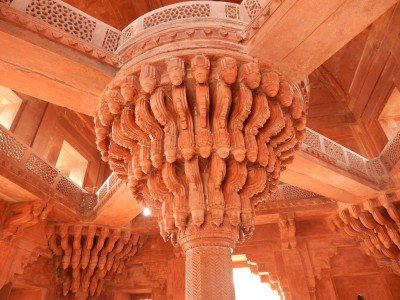 @@Historical Significance and Purpose::The Diwan-i-Khas is the most distinctive administrative building in the Fatehpur Sikri palace complex, built by Emperor Akbar in the 16th century. Though its name suggests a Hall of Private Audience, the unusual interior structure has led historians to propose several alternative theories, including a space for profound religious and philosophical debates (the Ibadat Khana) or even a royal treasury (Khazana). This single-chamber, square structure stands out due to its singular, massive central column. It was here, if used as the Hall of Private Audience, that Akbar would meet with his highest ministers, foreign dignitaries, and, most famously, scholars and spiritual leaders from various faiths to discuss theological doctrines under his unique syncretic faith, the Din-i Ilahi. The hall symbolized the Emperor's position as a 'Chakravartin' (World Ruler) who governed and deliberated from a position of centrality, transcending all groups. Its design is a physical representation of Akbar's non-sectarian and centralized authority. The structure is entirely made of deep red sandstone, showcasing the rich, detailed Mughal architectural style that blends traditional Hindu and Islamic elements. Its location near the other private and official buildings, such as the Treasury and the Diwan-i-Aam, underlines its importance in the imperial setup. The mystery surrounding its true original function adds an extra layer of fascination for visitors and historians. The hall truly represents the zenith of Akbar's architectural and philosophical vision for his new capital city, Fatehpur Sikri. It stands today as a silent witness to the intellectual ferment of the Mughal court during its golden age.
@@History and Purpose: This red sandstone tomb belongs to Islam Khan I (Shaikh Alauddin Chishti, 1570-1613), the grandson of the revered Sufi saint Sheikh Salim Chishti. Islam Khan was a prominent general in the Mughal army and was appointed the Subahdar (Governor) of Bengal by Emperor Jahangir. He moved the capital of Bengal to Dhaka and renamed it Jahangirnagar. His tomb was built in 1613 AD during the reign of Jahangir and is situated to the east of his grandfather’s white marble mausoleum, within the vast quadrangle of the Jama Masjid. It also houses the graves of other male descendants of Sheikh Salim Chishti. The tomb is a testament to the continued high regard the Mughal dynasty had for the Chishti family even after Akbar's death. @@Family Ties: It is a key monument in understanding the dynastic and spiritual ties that bound the Mughal court to the Chishti Silsila (Order).
@@Function and Historical Context of the Naubat Khana: The Naubat Khana, or Naqqar Khana (Drum House), is a large, rubble-masonry structure that served as the official musical chamber. It was strategically located at the main entry point to the inner imperial city, just before the path leads to the Diwan-i-Aam (Hall of Public Audience). Its primary function was to announce the arrival or departure of the Emperor Akbar and other significant royal personalities or dignitaries. The playing of ceremonial drums (Naubat), trumpets, and other instruments here marked the formal beginning of daily court proceedings, major festivals, and important public announcements. The custom of having a Naqqar Khana was a tradition common in many royal courts across India, symbolizing the monarch's presence and power. In Fatehpur Sikri, this structure formed a crucial part of the ceremonial processional route, creating a loud, dramatic entry sequence for anyone approaching the main palace complex. The music was not just noise; it was an integral part of the spectacle of kingship. The building itself is simple, contrasting with the ornate palaces, emphasizing its utilitarian and acoustic purpose. Some historical accounts also link the performances here to court musicians like Tansen.Show All
@@Historical Significance and Purpose::The Diwan-i-Khas is the most distinctive administrative building in the Fatehpur Sikri palace complex, built by Emperor Akbar in the 16th century. Though its name suggests a Hall of Private Audience, the unusual interior structure has led historians to propose several alternative theories, including a space for profound religious and philosophical debates (the Ibadat Khana) or even a royal treasury (Khazana). This single-chamber, square structure stands out due to its singular, massive central column. It was here, if used as the Hall of Private Audience, that Akbar would meet with his highest ministers, foreign dignitaries, and, most famously, scholars and spiritual leaders from various faiths to discuss theological doctrines under his unique syncretic faith, the Din-i Ilahi. The hall symbolized the Emperor's position as a 'Chakravartin' (World Ruler) who governed and deliberated from a position of centrality, transcending all groups. Its design is a physical representation of Akbar's non-sectarian and centralized authority. The structure is entirely made of deep red sandstone, showcasing the rich, detailed Mughal architectural style that blends traditional Hindu and Islamic elements. Its location near the other private and official buildings, such as the Treasury and the Diwan-i-Aam, underlines its importance in the imperial setup. The mystery surrounding its true original function adds an extra layer of fascination for visitors and historians. The hall truly represents the zenith of Akbar's architectural and philosophical vision for his new capital city, Fatehpur Sikri. It stands today as a silent witness to the intellectual ferment of the Mughal court during its golden age.
@@History and Purpose: This red sandstone tomb belongs to Islam Khan I (Shaikh Alauddin Chishti, 1570-1613), the grandson of the revered Sufi saint Sheikh Salim Chishti. Islam Khan was a prominent general in the Mughal army and was appointed the Subahdar (Governor) of Bengal by Emperor Jahangir. He moved the capital of Bengal to Dhaka and renamed it Jahangirnagar. His tomb was built in 1613 AD during the reign of Jahangir and is situated to the east of his grandfather’s white marble mausoleum, within the vast quadrangle of the Jama Masjid. It also houses the graves of other male descendants of Sheikh Salim Chishti. The tomb is a testament to the continued high regard the Mughal dynasty had for the Chishti family even after Akbar's death. @@Family Ties: It is a key monument in understanding the dynastic and spiritual ties that bound the Mughal court to the Chishti Silsila (Order).
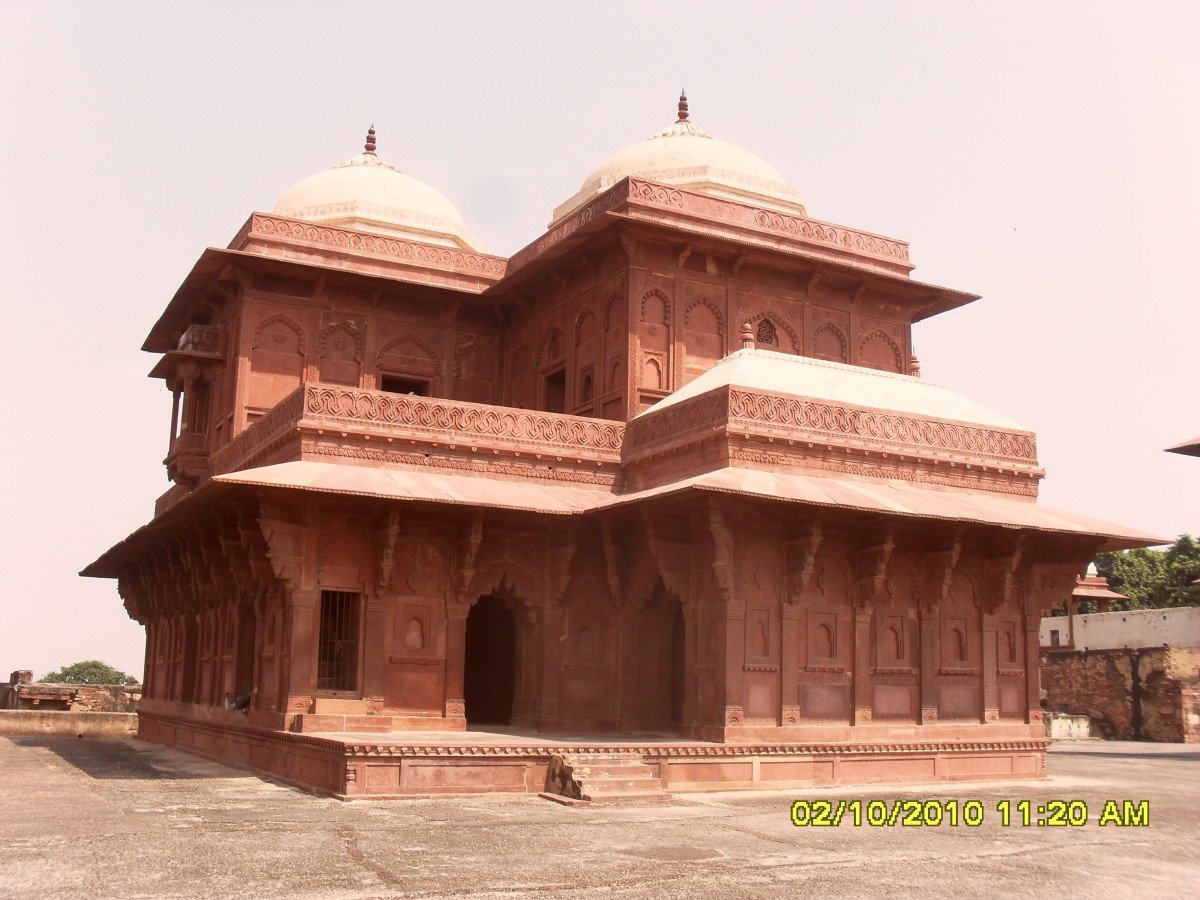
@@Function and Historical Context of the Naubat Khana: The Naubat Khana, or Naqqar Khana (Drum House), is a large, rubble-masonry structure that served as the official musical chamber. It was strategically located at the main entry point to the inner imperial city, just before the path leads to the Diwan-i-Aam (Hall of Public Audience). Its primary function was to announce the arrival or departure of the Emperor Akbar and other significant royal personalities or dignitaries. The playing of ceremonial drums (Naubat), trumpets, and other instruments here marked the formal beginning of daily court proceedings, major festivals, and important public announcements. The custom of having a Naqqar Khana was a tradition common in many royal courts across India, symbolizing the monarch's presence and power. In Fatehpur Sikri, this structure formed a crucial part of the ceremonial processional route, creating a loud, dramatic entry sequence for anyone approaching the main palace complex. The music was not just noise; it was an integral part of the spectacle of kingship. The building itself is simple, contrasting with the ornate palaces, emphasizing its utilitarian and acoustic purpose. Some historical accounts also link the performances here to court musicians like Tansen.Show All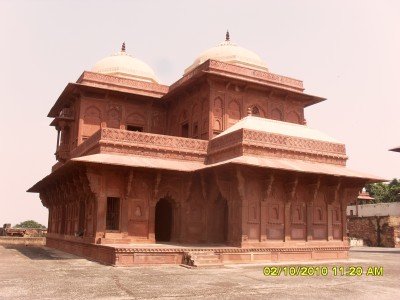 @@Historical Identity and Controversy: This two-storeyed building is popularly known as the residence of Raja Birbal, Emperor Akbar’s most trusted courtier, poet, and one of the nine gems (Navratnas) renowned for his wit. However, most historians now believe that the palace, due to its size, security, and location within the Haram Sara (Imperial Women's Quarters) complex near Jodha Bai's Palace, was more likely used to house Akbar's senior queens, possibly Ruqaiya Begum and Salima Sultan Begum. Despite the historical debate, its name remains an enduring part of the Fatehpur Sikri legend, symbolizing the high esteem in which Birbal was held. The structure is an exquisite example of the architectural synthesis that characterized Akbar's reign, blending intricate Hindu and Islamic elements seamlessly in a residential setting. @@Architectural Fusion and Comfort: Constructed entirely of durable red sandstone, the house is a compact masterpiece, complex in its internal arrangement and highly detailed in its exterior ornamentation. Its design prioritizes natural cooling and privacy. The upper storey features two cupola-roofed rooms and open terraces enclosed by finely carved lattice screens (jali), which provided secluded views and excellent ventilation. The roofs are built on a modified double-dome system to ensure thermal comfort. The ground floor consists of four rooms and two porches. The most striking features are the intricately carved brackets supporting the wide eaves (chhajja), which are more elaborate and numerous here than in almost any other secular building in Fatehpur Sikri. This liberal use of rich carving and bracket supports makes it an iconic example of the Mughal-Rajput style. @@Interior Layout and Atmosphere: The interior spaces are small but intelligently designed. The transition from the shaded lower porches to the private upper chambers creates a sense of intimacy and seclusion. The decorative work on the walls and ceilings is less grand than the public halls but more domestically detailed. The house reflects a high degree of craftsmanship and material wealth, consistent with a residence for either a top minister or the principal queens. It provides a human-scale contrast to the monumental architecture of the nearby Diwan-i-Aam and Buland Darwaza, offering a glimpse into the domestic life of the elite 16th-century court.
Information
-
Why Famous:
UNESCO Site: It is globally famous as a UNESCO World Heritage site and one of the best-preserved examples of Mughal architecture in the world.
Buland Darwaza: Renowned as the 'Gate of Victory', it is an iconic symbol of Mughal power and arch...UNESCO Site: It is globally famous as a UNESCO World Heritage site and one of the best-preserved examples of Mughal architecture in the world.
Buland Darwaza: Renowned as the 'Gate of Victory', it is an iconic symbol of Mughal power and architectural ambition that attracts millions of visitors. -
Architecture:
Buland Darwaza: This 54-meter-high gateway is the highest in the world, built to commemorate Akbar’s victory over Gujarat with massive red sandstone and marble.
Panch Mahal: A unique five-story wind tower with 176 intricately carved pillar...Buland Darwaza: This 54-meter-high gateway is the highest in the world, built to commemorate Akbar’s victory over Gujarat with massive red sandstone and marble.
Panch Mahal: A unique five-story wind tower with 176 intricately carved pillars, designed for the royal ladies to enjoy the cool breeze without being seen.
Salim Chishti Tomb: A delicate white marble structure surrounded by carved lattice screens (Jalis), representing the pinnacle of Mughal craftsmanship and spiritual elegance. -
How To Reach:
By Air: The nearest airport is in Agra (35 KMs), but most international travelers use Delhi Airport (230 KMs) and then travel by road or rail.
By Train: Fatehpur Sikri has its own small station, but Agra Cantt is the major hub with high-spee...By Air: The nearest airport is in Agra (35 KMs), but most international travelers use Delhi Airport (230 KMs) and then travel by road or rail.
By Train: Fatehpur Sikri has its own small station, but Agra Cantt is the major hub with high-speed trains like Gatimaan Express from Delhi.
By Road: It is a smooth 1-hour drive from Agra via the Bikaner-Agra highway; numerous private taxis and government buses run this route frequently.
Local Transport: From the parking area, eco-friendly electric buses transport visitors to the main monument gate to maintain the site's environment. -
Weather and Best Time to Visit:
Winter Months: October to March is the peak season with cool weather, making the extensive walking required to see the complex very comfortable.
Spring Beauty: February and March offer clear blue skies that provide a perfect contrast to the ...Winter Months: October to March is the peak season with cool weather, making the extensive walking required to see the complex very comfortable.
Spring Beauty: February and March offer clear blue skies that provide a perfect contrast to the red sandstone, ideal for professional photography. -
Near Tourist Places:
1. Agra (35 KMs), 2. Bharatpur Bird Sanctuary (25 KMs), 3. Mathura (65 KMs), 4. Vrindavan (75 KMs), 5. Deeg Palace (60 KMs), 6. Gwalior (150 KMs), 7. Alwar (160 KMs), 8. Jaipur (210 KMs), 9. Delhi (230 KMs), 10. Dholpur (60 KMs)
Tourism Tips
-
Health & Safety: Carry plenty of water and wear a hat as the stone complex can get very hot; beware of unauthorized guides and persistent street vendors.
Packing Essentials: Comfortable walking shoes are mandatory as the site is huge; wear...Health & Safety: Carry plenty of water and wear a hat as the stone complex can get very hot; beware of unauthorized guides and persistent street vendors.
Packing Essentials: Comfortable walking shoes are mandatory as the site is huge; wear modest clothing when entering the Dargah or Jama Masjid area.
Accommodation: Most visitors stay in Agra, but there are a few decent heritage hotels and government guest houses in Fatehpur Sikri for an overnight stay.
Travel Tip: Use the official audio guide if you prefer exploring at your own pace; it provides accurate historical data without the pressure of a human guide.
Reviews
FAQs
Fatehpur Sikri Itineray And Cost:-
Other Places In Uttar Pradesh :-
Other States In India :-
Information about New and Updated Locations() of Uttar Pradesh Has Been Added :-
Card subtitle
Note:-
Information provided here in good Faith and for reference only.
Near Places
Agra
Some quick example text to build on the card title and make up the bulk of the card's content.
Go somewhere
Aligarh
Some quick example text to build on the card title and make up the bulk of the card's content.
Go somewhere
Ayodhya
Some quick example text to build on the card title and make up the bulk of the card's content.
Go somewhere
Azamgarh
Some quick example text to build on the card title and make up the bulk of the card's content.
Go somewhere
Bahraich
Some quick example text to build on the card title and make up the bulk of the card's content.
Go somewhere
Bareilly
Some quick example text to build on the card title and make up the bulk of the card's content.
Go somewhere
Chitrakoot
Some quick example text to build on the card title and make up the bulk of the card's content.
Go somewhere
Fatehpur Sikri
Some quick example text to build on the card title and make up the bulk of the card's content.
Go somewhere
Ghaziabad
Some quick example text to build on the card title and make up the bulk of the card's content.
Go somewhere
Gorakhpur
Some quick example text to build on the card title and make up the bulk of the card's content.
Go somewhere
Hastinapur
Some quick example text to build on the card title and make up the bulk of the card's content.
Go somewhere
Jhansi
Some quick example text to build on the card title and make up the bulk of the card's content.
Go somewhere
Kanpur
Some quick example text to build on the card title and make up the bulk of the card's content.
Go somewhere
Kushinagar
Some quick example text to build on the card title and make up the bulk of the card's content.
Go somewhere
Lucknow
Some quick example text to build on the card title and make up the bulk of the card's content.
Go somewhere
Mathura
Some quick example text to build on the card title and make up the bulk of the card's content.
Go somewherein Other Cities